
Choosing Between Crowns and Veneers for Your Tooth

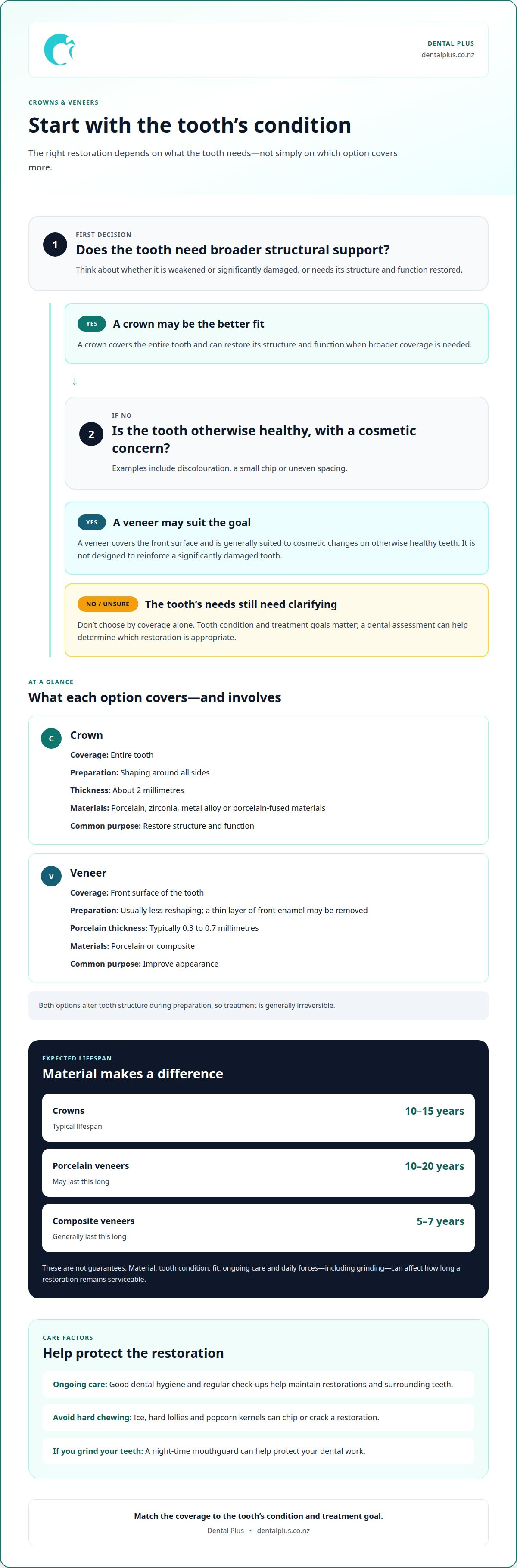
A crown isn’t automatically the better choice just because it covers more of a tooth. When choosing between crowns and veneers, the tooth’s condition matters: crowns cover the entire tooth and can restore its structure, while veneers cover the front surface and are generally suited to cosmetic changes on otherwise healthy teeth.
It makes sense to want a natural-looking result while preserving as much healthy tooth as possible. Veneers usually require less shaping than crowns, but they aren’t designed to reinforce a significantly damaged tooth. Crowns typically last 10 to 15 years, while porcelain veneers may last 10 to 20 years; the material, tooth condition and ongoing care all matter.
This guide explains how crowns and veneers differ in coverage, tooth preparation and lifespan, and when each may suit your needs. You’ll also learn why veneers can be a thoughtful option for improving the appearance of healthy teeth, including concerns such as discolouration, small chips or uneven spacing.
Table of Contents
What Are Crowns and Veneers?
A dental crown covers the entire tooth, while a veneer is a thin covering bonded to its front surface. That difference affects preparation: a crown requires shaping around the tooth, whereas a veneer generally needs less reshaping at the front.
Full-coverage crowns
A crown encases the entire tooth, restoring its structure and function when it needs broader coverage. Crowns can be made from porcelain, zirconia, metal alloy or porcelain-fused materials. A crown is about 2 millimetres thick, and its full covering differs from a veneer’s front-only placement.
Because a crown surrounds the tooth, preparation involves shaping all sides rather than just the front enamel. For example, a tooth needing support across its surfaces may be better suited to full coverage than to a cosmetic covering limited to the visible front.
Front-surface veneers
A veneer is a thin shell, commonly made from porcelain or composite material, bonded to the front of a tooth. Porcelain veneers are typically 0.3 to 0.7 millimetres thick. Their limited covering can improve the appearance of an otherwise healthy tooth with discolouration, a small chip or uneven spacing.
Veneer preparation usually removes a thin layer of front enamel so the restoration fits flush. Unlike a crown, a veneer doesn’t encase the tooth or provide full coverage. Its role is primarily cosmetic, rather than restoring a tooth that needs broader structural support.
When choosing between crowns and veneers, match the coverage to the tooth: broader structural restoration points towards a crown, while a cosmetic change to a healthy front surface may suit a veneer.
Porcelain and composite veneers both cover the front of a tooth, but use different materials. Porcelain and zirconia crowns are among the full-coverage options; metal alloy and porcelain-fused materials are also used for crowns. The material and coverage help determine whether the restoration is intended mainly to improve appearance or provide broader restoration.
If a crown or veneer chips or fails, some damage may be repairable, while other cases require replacement. The extent of the chip and the condition of the underlying tooth guide the treatment. A dental assessment can determine whether the existing restoration can remain in place.
Regular dental check-ups and good dental hygiene help maintain crowns, veneers and surrounding teeth. Avoid chewing ice, hard lollies or popcorn kernels, which can chip or crack a restoration. If you grind your teeth, a night-time mouthguard can help protect your dental work.
Crowns and veneers lifespan
Crowns typically last 10 to 15 years, while porcelain veneers may last 10 to 20 years. Composite veneers generally last 5 to 7 years, and material, tooth condition and grinding can affect how long each restoration remains serviceable.
Crown durability
A crown’s typical lifespan is 10 to 15 years, although it can last longer with proper care. Material also matters: a 2026 systematic review reported a five-year survival rate of 96.8 per cent for monolithic zirconia crowns. That figure describes survival over five years, not a guaranteed lifespan for an individual crown.
Daily bite forces and the condition of the tooth beneath a crown influence its durability. A crown on a heavily used tooth faces different demands from one on a less-loaded tooth. Good dental hygiene and regular check-ups help maintain the restoration and identify changes that need assessment.
Veneer durability
Porcelain veneers may last 10 to 20 years, while composite veneers generally last 5 to 7 years. A 2012 study estimated porcelain veneer survival at 93.5 per cent after 10 years and 82.9 per cent after 20 years. These estimates show why the material and length of follow-up matter when comparing lifespan claims.
Composite veneers have a shorter typical lifespan, although their performance varies between cases. A 2023 meta-analysis found an 88 per cent pooled survival rate for composite veneers across follow-ups of roughly 2 to 8 years. Survival rates describe groups, so they don’t predict the exact outcome for one person.
Grinding can place added stress on veneers. A 2012 study reported a 7.7-times greater veneer failure risk for patients who clench or grind their teeth. That finding makes bite habits relevant to treatment planning, particularly when a veneer is being considered for a tooth exposed to repeated pressure.
Material alone doesn’t determine how long a restoration lasts. The tooth’s condition, the restoration’s fit and daily forces all matter. For example, a porcelain veneer may remain intact while the tooth beneath it develops a problem. The restoration’s condition and the tooth’s ongoing health are related, but they are not the same measure.
If a restoration chips, loosens or changes, arrange a dental assessment. The dentist can examine the damage and the tooth beneath it, then determine whether repair or replacement is appropriate. The extent of the damage and the restoration’s condition guide that decision.
To compare options for your tooth, a crowns and veneers assessment can consider material, grinding and the restoration’s expected demands together.
Tooth preparation and enamel removal
Crowns and veneers both alter tooth structure during preparation, so treatment is generally irreversible. Key risks include removing healthy enamel and temporary sensitivity to hot or cold after preparation.
Tooth preparation
Preparation shapes a tooth so a restoration fits securely and comfortably. For a crown, the dentist shapes all sides because the covering surrounds the tooth. A veneer requires preparation mainly at the front. The amount depends on the tooth and restoration, but crowns generally involve more shaping across the tooth than veneers.
Enamel removal
Veneer preparation removes a thin layer of enamel from the front surface, about half a millimetre in one description. This makes room for the veneer to fit flush rather than appear bulky. Crown preparation is more extensive because the crown covers the whole tooth.
That difference matters because enamel removal cannot be reversed. A veneer changes the front surface, while crown preparation reshapes the tooth on all sides. A tooth prepared for a veneer, for example, has less preparation beyond its visible front than one prepared for full coverage. The dentist weighs the tooth’s condition and the coverage needed before shaping it.
After preparation, a traditional crown is usually protected with a temporary crown while the permanent restoration is made. The temporary covering protects the prepared tooth during this stage, but it isn’t the final restoration. Veneer cases don’t always need a temporary covering, so the steps depend on the treatment and the amount of preparation.
Some people experience sensitivity to hot and cold after crown or veneer preparation. It may subside within a few days or weeks. The prepared tooth can feel different before the permanent restoration is placed. Tell your dentist about persistent or increasing sensitivity so they can assess the tooth and restoration.
Placement also involves securing the restoration with dental cement. After placement, avoid food for 1-2 hours to allow the cement to set, and avoid very hard or sticky foods for the first day. These steps reduce pressure on a newly placed crown or veneer while the cement settles.
The practical trade-off is clear: veneers usually preserve more tooth structure, while crowns require more extensive preparation to provide full coverage. Because both treatments permanently change the tooth, preparation should match its condition and the restoration’s purpose.
Choosing based on tooth condition and treatment goals
The tooth’s strength and your treatment goal point towards different restorations. A cracked tooth needing support is not the same case as healthy enamel with a cosmetic concern.
Options by tooth condition
For a structurally healthy tooth, a veneer may suit cosmetic changes such as concealing discolouration, a small chip or uneven spacing. A crown may be more suitable when the tooth is weak or compromised and needs broader restoration. The distinction is practical: a veneer changes the visible appearance, while a crown can restore a tooth’s structure and function.
To choose, consider the amount of sound tooth structure, existing fillings, decay, cracks and your desired outcome. For example, a healthy front tooth with staining may suit a veneer, while extensive decay shifts the decision towards restoring strength. Bite habits matter too: people who grind their teeth or have bite-related issues may be better suited to a crown.
Crowns for damaged teeth
A crown may be recommended for a significantly damaged, cracked or worn tooth, a tooth with a large filling, or one that has had root canal treatment. These conditions can leave less sound tooth structure to support a cosmetic restoration on the front surface. A crown provides broader coverage for the remaining tooth.
Back teeth also face heavy chewing forces, so a crown may be considered when damage or weakness affects their function. Root canal treatment is another important factor: a 2002 study reported that root-canal-treated teeth without crowns were lost at a 6.0 times greater rate than crowned teeth. This finding supports considering protection after treatment.
Veneers aren’t designed to reinforce a tooth with extensive decay, significant damage or previous root canal treatment. Placing one over a compromised tooth would address appearance without providing the broader support the tooth may need. By contrast, a veneer can suit a healthy tooth when the main concern is its visible shape or colour.
Existing dental work influences the choice. A large filling can leave less natural structure, making a crown more appropriate than a cosmetic veneer. Small chips or uneven spacing on otherwise healthy teeth point towards a different goal: refining the visible surface while retaining more of the tooth.
The treatment decision starts with the tooth, not the preferred restoration. A dentist assesses its condition, bite and existing work, then weighs those findings against your desired result. A stained but sound tooth, for example, presents a different treatment need from a cracked tooth that has undergone root canal treatment.
Cosmetic reasons to choose a veneer
A veneer can refine the visible surface of a structurally healthy tooth without covering it entirely. This makes it a cosmetic option for concerns such as discolouration, small chips or uneven spacing, particularly on front teeth. The key distinction is purpose: veneers address appearance, while a crown may be needed when a tooth also requires broader restoration.
Consider a healthy front tooth with a small chip. A veneer can cover the visible defect and adjust the tooth’s shape while leaving the back surface uncovered. For uneven spacing, veneers may help create a more balanced appearance across the visible teeth. These options suit teeth that remain sound and don’t need reinforcement.
Porcelain and composite veneers can both be bonded to the front surface. Material is part of planning the aesthetic result, alongside the tooth’s existing colour, shape and position. A veneer is designed for an individual tooth, so its appearance should sit naturally beside neighbouring teeth rather than look like a separate covering.
Veneers have limits. They aren’t suitable for teeth with significant decay or damage, or teeth that need reinforcement after root canal treatment. In those cases, improving appearance alone wouldn’t address the tooth’s structural needs. A crown may be more appropriate for a compromised tooth, while a veneer may suit a sound tooth with a cosmetic concern.
Enamel preparation also matters. Veneer placement usually involves removing a thin layer from the front surface so the bonded restoration fits flush. This change to the natural tooth is irreversible. If you’re seeking a cosmetic improvement, weigh the expected appearance against permanent enamel alteration.
A porcelain-fused-to-metal crown can sometimes show a thin dark line between the natural tooth and the restoration. This illustrates why the visible result depends on the type of restoration and where it sits. A veneer may be considered when the tooth is healthy and the aim is to improve its visible surface, rather than cover it completely.
Good care supports both the restoration and the natural teeth around it. Regular dental check-ups and professional dental hygiene help maintain oral health, while avoiding chewing ice or hard lollies can reduce the risk of chipping. These habits matter whether your cosmetic treatment is a veneer or another restoration.
The clearest takeaway is to match the treatment to the tooth: veneers suit cosmetic changes to healthy front teeth, while damaged or weakened teeth may need broader support. Discuss your cosmetic treatment options in light of your tooth’s condition and the result you want.
Dental Plus: Crowns & Veneers
Dental Plus provides crowns and veneers for patients considering restorative or cosmetic treatment in Tauranga. A dental assessment and discussion of your goals can help clarify whether a tooth needs broader coverage or a cosmetic change. The dentists consider the tooth’s condition alongside the result you want, so treatment planning reflects both function and appearance.
Routine check-ups and digital X-rays can support assessment of your teeth and oral health. If a crown or veneer is suitable, Dental Plus can discuss the treatment option with you. Regular professional dental hygiene also helps you maintain your teeth and restorations.
For a considered discussion of crowns and veneers, contact Dental Plus.
Take the next step towards a considered treatment plan
The next step is to connect your preferred result with the health and needs of the tooth. Before treatment planning, consider what you most want to change, such as a tooth’s shape, colour or comfort when biting. This gives the conversation a clear starting point without making appearance the only consideration.
Choosing between crowns and veneers is a personal decision, and a dental assessment can relate your goals to the condition of your teeth. Discuss what matters to you, raise concerns about preparation or ongoing care, and find out which options suit your circumstances. The plan should be clear before you decide how to proceed.
For a calm conversation about your options, contact Dental Plus for advice. A thoughtful discussion is a positive first step towards care that feels right for you.
Frequently Asked Questions
What About Cost?
The cost depends on the treatment plan, including the restoration material, number of teeth and preparation needed. If a tooth also needs treatment for decay or damage, that can affect the overall plan. In New Zealand, ask for a written treatment plan and cost estimate after examination, so you understand the proposed work before deciding whether to proceed.
How do you know which one is right for you?
The tooth’s health, strength, bite and appearance all help determine a suitable option. A healthy tooth with a colour concern, for example, presents a different need from one with a crack or extensive decay. In Tauranga, a dental assessment can bring these factors together with your goals, such as changing a visible tooth’s shape or restoring comfort when chewing.
What are dental crowns?
A dental crown is a restoration that fits over a tooth to restore its shape and function. It can be made from materials such as porcelain, zirconia, metal alloy or porcelain-fused material. A tooth with substantial damage, for example, may need coverage beyond its visible front. The crown’s material and design depend on the tooth and the demands placed on it.
What are dental veneers?
A dental veneer is a thin restoration bonded to the front of a tooth. Porcelain and composite are common veneer materials, and treatment is generally intended to improve appearance rather than reinforce a weakened tooth. A veneer may be considered for a healthy front tooth with a small chip, for instance. The surrounding teeth help inform the planned colour and shape.
What’s involved with getting a veneer?
Getting a veneer involves assessing the tooth, planning its appearance, preparing the surface where needed, then bonding the veneer in place. Treatment typically takes two visits, although the steps depend on the material and the case. The dentist considers how the veneer will sit against nearby teeth and checks its fit and bite at placement, so the restoration feels comfortable in everyday use.
Which One Looks More Natural?
Neither option is automatically more natural-looking; the result depends on the tooth, material and restoration design. A veneer can refine the visible front of a healthy tooth, while a crown covers more of it. A front tooth’s colour and shape can be planned alongside neighbouring teeth. A porcelain-fused-to-metal crown may show a thin dark line at the gum edge.
When are crowns recommended instead of veneers, and vice versa?
A crown is generally considered when a tooth is cracked, extensively worn, significantly decayed, has a large filling or has undergone root canal treatment. A veneer may suit an otherwise healthy tooth where the main concern is appearance, such as discolouration or uneven spacing. The deciding difference is whether the tooth needs broader restoration or a cosmetic change to its visible surface.
How much do crowns and veneers cost in New Zealand?
There isn’t one cost that applies to every crown or veneer treatment in New Zealand. The estimate depends on factors such as the material, number of teeth, preparation required and the tooth’s condition. Dental Plus provides a treatment plan with a cost estimate after examination. This helps you understand the proposed treatment and its cost before significant work begins.
Comments