
Adult Braces Cost in NZ: Prices, Fees and What’s Included

The cheapest-looking braces option isn’t necessarily the least expensive way to achieve a healthy, lasting result. Adult braces cost in NZ depends on the treatment type, the complexity of tooth movement and what the fee includes. Your individual fee is set after a quote request, with those factors shaping the estimate.
It’s understandable to want a clear figure before deciding whether treatment fits your budget. Orthodontics New Zealand advises getting an all-inclusive financial quote in writing, alongside a comprehensive diagnostic report, to clarify expected costs and help avoid surprises.
This guide explains what braces fees may cover, how treatment options compare and what can affect treatment duration. You’ll also learn how payment arrangements can help with budgeting, giving you a clearer picture of the process and costs involved.
Table of Contents
How Much Do Braces Cost?
Braces costs in New Zealand depend on the movements required, treatment length and appliances used. A written, all-inclusive quote helps you understand the proposed fee before treatment begins.
Comparing written all-inclusive quotes
An all-inclusive quote sets out the expected treatment fee and what it covers in writing. Orthodontics New Zealand advises getting this quote alongside a comprehensive diagnostic report from a specialist orthodontist. Together, these documents explain the treatment plan and make comparisons clearer. Look for the proposed appliance, appointments and any stated exclusions, rather than judging two quotes by their totals alone.
The price depends on your case and is provided after a quote request. Factors include the complexity of tooth movement, bite correction, treatment type and expected duration. Compare plans by asking the same questions: what treatment is proposed, what does the fee include, and which costs fall outside it? For example, compare a quote that separates adjustment visits from the main fee with one that states an all-inclusive total.
Read the treatment plan: check which teeth and bite concerns the proposed approach addresses.
Compare included care: note how the quote describes appointments, adjustments and follow-up.
Identify exclusions: record any additional charges or services not covered by the quoted fee.
This approach gives you a more like-for-like basis for comparing treatment plans. It also makes the financial commitment easier to understand before you agree to proceed.
Braces and clear aligners
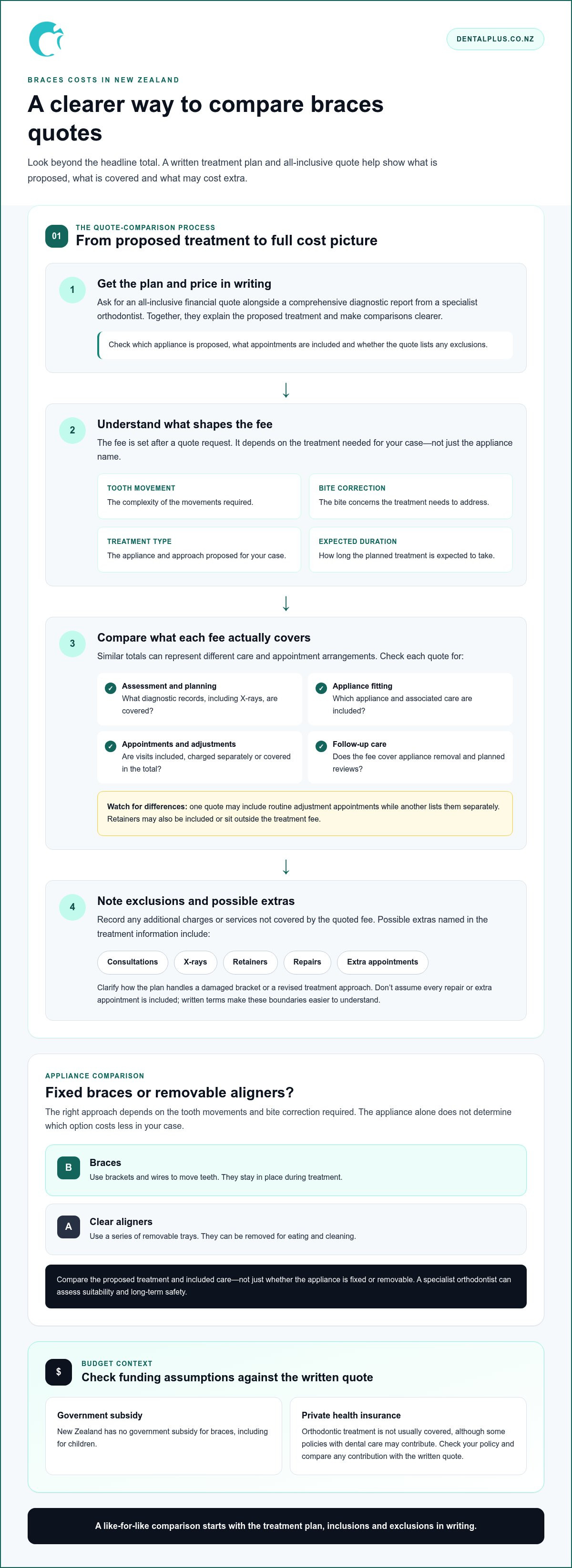
Braces use brackets and wires to move teeth, while clear aligners use a series of removable trays. Both can address orthodontic concerns, but the suitable method depends on the tooth movements and bite correction required. Orthodontics New Zealand recommends consulting a specialist orthodontist before orthodontic treatment, including clear aligners, to assess suitability and long-term safety.
Compare the proposed treatment and included care, not just whether the appliance is fixed or removable. Braces stay in place during treatment, while aligners are removed for eating and cleaning. These practical differences can affect daily routines, but they don’t determine which option costs less in your case. A written plan explains the approach being priced.
New Zealand has no government subsidy for braces, including for children. Private health insurance does not usually cover orthodontic treatment, although some policies with dental care may contribute. Check how your policy treats orthodontics when planning your budget, and compare any contribution with the written treatment quote.
For adults weighing the cost of braces against clear aligners, the treatment plan is the key comparison. The number and type of movements, bite needs and treatment duration shape the proposed approach. A comprehensive diagnostic report helps explain why an orthodontist recommends one method over another, while an all-inclusive quote clarifies the expected financial commitment.
What is included in my braces fee?
Braces fees may cover assessment, appliance fitting, adjustment appointments and follow-up care. Depending on the treatment plan and quoted inclusions, extra costs can include consultations, X-rays, retainers or repairs.
Consultation and follow-up fees
Consultation and follow-up fees relate to assessment, progress reviews and adjustments during treatment. Check how these fit into the total, since a low initial figure may not represent the full treatment commitment.
Most orthodontists in New Zealand offer a free first consultation. The quote should clarify whether later appointments are included, charged separately or covered within an overall treatment fee. Ask how adjustment visits are handled, since braces need ongoing monitoring as teeth move. A written explanation helps you understand what happens after the initial assessment.
Follow-up care also matters near the end of active treatment. Clarify whether the quoted fee covers appliance removal and any planned reviews. These details help you compare the full course, rather than focusing only on the first appointment or fitting.
What braces fees may include
A braces fee may bundle several parts of treatment into one total, but inclusions differ between quotes. The same headline figure can represent different care and appointment arrangements.
Read the quote for a clear description of assessment, treatment planning, fitting, adjustments and follow-up. Check whether diagnostic records, such as X-rays, are included or listed separately. The quote should also explain the appliance being used and the associated care. If a term is unclear, ask for its meaning in writing before comparing totals.
For example, one quote might include routine adjustment appointments, while another lists them separately. Retainers could also be included or sit outside the treatment fee. These differences affect the overall budget, even when initial totals look similar. Keep a simple comparison note of each quote’s inclusions, exclusions and payment schedule.
Check how the plan handles changes during treatment, including a damaged bracket or a revised approach. Don’t assume every repair or extra appointment is included in the quoted amount. Written terms make those boundaries easier to understand and reduce confusion about later charges.
Possible extra treatment costs
Possible extras are treatment-related items charged outside the main fee, such as imaging, retainers or repairs. Identify them because they can affect the total cost beyond active braces treatment.
Check whether retainers are included in the treatment quote or priced separately. X-rays may form part of diagnostic records, so look for how they’re treated in the written estimate. Repairs can also arise if an appliance is damaged, so clarify how the quote addresses them.
Use a short checklist when reviewing the written fee:
Consultations: note whether the first visit and later reviews are included.
Records: identify whether diagnostic X-rays are covered or separate.
Retainers: check whether the fee includes them after braces.
Repairs: find out how damaged appliances are handled under the quote.
For a clearer starting point, explore braces treatment information alongside the details in your written estimate.
New Zealand braces price ranges by treatment type
The amount depends on the appliance and the orthodontic work required. Comparing treatment types helps you understand what shapes a personalised quote.
New Zealand has no government subsidy for braces, including for children. ACC is separate from a general braces subsidy. Any injury-related assessment depends on the circumstances of the claim.
The price depends on your case and is provided after a quote request. Cost factors include treatment type, tooth movements, bite correction and the care included in the plan. These factors explain why an advertised starting figure may not match the full fee for an individual course of treatment.
New Zealand treatment options include traditional metal braces, ceramic clear braces, lingual braces and clear aligners, including Invisalign. Each uses a different appliance, and the quote reflects the plan required for the patient’s teeth and bite. For example, a plan focused on front-tooth appearance differs from one that also corrects the bite. Comparing labels alone won’t show whether two quotes cover similar treatment.
Metal braces: fixed brackets and wires move teeth according to the treatment plan.
Ceramic braces: tooth-coloured brackets provide a less noticeable fixed option.
Lingual braces: brackets sit on the inner surfaces of teeth.
Clear aligners: removable trays guide tooth movement in planned stages.
Clear aligners can suit some treatment plans, but they aren’t automatically appropriate for every bite or tooth movement. Orthodontics New Zealand recommends consulting a specialist orthodontist before orthodontic treatment, including clear aligners, to assess suitability and long-term safety. The diagnosis and proposed movements matter more than choosing an appliance based on appearance alone. A written quote should connect the recommended option with the treatment objectives.
Quotes in Tauranga and elsewhere can differ in what they include and how appointments are arranged. Location alone doesn’t tell you whether two fees cover equivalent care. Compare the treatment plan, diagnostic records, adjustment visits and follow-up provisions. If you’re travelling from a rural area, appointment frequency and travel requirements may also affect practical budgeting, even when those costs sit outside the orthodontic fee.
Use the same comparison points for every location and appliance: treatment goals, included appointments, exclusions and payment arrangements. This makes quotes easier to assess without treating a city or rural address as a reliable price guide. Ask for the proposed treatment and full fee in writing, then compare like with like. The written plan should make clear what the fee covers and what may be charged separately.
Aligners vs Braces: What’s Affordable in NZ?
Affordability depends on the treatment plan and how you prefer to pay. Compare the total commitment, not just the instalment amount.
Payment plans and instalments
A payment plan spreads an agreed treatment fee across scheduled instalments. This can make budgeting more manageable by avoiding one large upfront payment.
Some New Zealand providers offer interest-free orthodontic payment plans over 12-24 months. “Interest-free” describes the interest charged, so read the written terms for the payment schedule and total payable. Check how the plan aligns with treatment appointments and whether the quoted fee includes the full course of care.
Compare plans using the same details for each option: the total treatment fee, deposit, instalment amount, payment frequency and plan length. For example, a lower regular instalment may run for longer, while a larger instalment may clear the balance sooner. The schedule matters as much as the amount due at each payment.
Keep treatment suitability separate from payment preference. Braces and clear aligners work differently, and the recommended option depends on the tooth movements and bite correction required. A payment plan changes how you pay, not which treatment is appropriate. Compare the written treatment proposal first, then assess the available payment structure against your household budget.
Total payable: compare the full amount rather than one instalment.
Schedule: note the deposit, payment frequency and plan duration.
Terms: read the written conditions alongside the treatment quote.
Paying upfront
Upfront payment means paying the agreed treatment fee at the start, rather than spreading it across instalments. It gives you a clear payment point, which can simplify budgeting if the funds are already available.
Before choosing this approach, compare the written fee with the payment-plan total and schedule. Paying upfront isn’t automatically more affordable if it leaves less room in your budget for regular expenses. Consider the effect on your cash flow throughout treatment, including routine living costs.
Choosing aligners or braces is also a question of practical fit, not just payment timing. Removable aligners need to be taken out for eating and cleaning, while fixed braces remain in place. These differences can affect daily habits, but neither option is universally cheaper. Treatment complexity, bite needs and planned tooth movements shape the quote.
A useful comparison starts with the same treatment goal for each option. Review the proposed appliance, what the fee covers and how payments are scheduled. If one plan uses instalments, assess the full payment period; if another requires upfront payment, consider the effect on your available savings. This gives you a clearer view of affordability without confusing a convenient payment structure with a lower treatment cost.
Treatment duration by brace type
Treatment time depends on the appliance and the tooth movements planned. In New Zealand, listed full-course orthodontic treatment prices typically cover 15 to 24 months.
That range is a broad planning guide, not a promise for every treatment. The diagnosis, bite correction and amount of tooth movement affect the proposed timeline. A plan focused on straightening visible front teeth differs from one addressing the bite across both arches. These goals help explain why two people using similar appliances may have different treatment schedules.
Typical duration ranges differ by appliance:
Metal braces: treatment typically takes 18 to 36 months.
Lingual braces: treatment typically takes 12 to 36 months.
Clear aligners: treatment is described as taking 4 to 6 months.
These figures describe different treatment categories, so don’t compare them without considering the treatment goals. The clear-aligner duration may not represent a full course for every case. Limited orthodontic treatment that improves front-tooth appearance without correcting the bite may take about 6 months. The treatment plan clarifies which movements the expected duration covers.
Ceramic braces use a different bracket material, but the treatment timeline depends on the movements required. Material choice alone doesn’t establish how long treatment will take. The same principle applies when comparing metal braces with lingual braces: appliance position is only one part of the plan. The complexity of tooth movement and bite correction also matters.
Duration also affects practical planning. Metal braces may involve a longer treatment period than a limited front-teeth plan, for example. Consider how regular appointments fit around work, study and travel, particularly if reviews require time away. Your written treatment plan should set out the expected timeline and review arrangements, so you can understand the commitment alongside the appliance choice.
During treatment, progress reviews allow the orthodontist to assess tooth movement and adjust the plan. Following care instructions for braces or aligners supports the planned process. For clear aligners, wearing the trays as directed is part of treatment; with fixed braces, keeping appointments supports ongoing monitoring. These steps help keep treatment aligned with its clinical goals.
Compare the expected duration with the outcome each plan aims to achieve. Ask how the timeline relates to bite correction, whether the plan addresses front teeth only, and what follow-up happens after active treatment. These details make duration a more useful comparison than the appliance label alone.
Dental Plus: Professional Dental Hygiene
Dental Plus offers Professional Dental Hygiene to support your ongoing oral care. Regular check-ups and hygiene visits can help you care for your teeth and gums during orthodontic treatment. Digital X-Rays can provide diagnostic images when needed as part of dental care.
If you’re considering braces, a routine check-up at Dental Plus in Tauranga can help you discuss your oral health and treatment goals. Digital Smile Design (DSD) is also available if you’re exploring how cosmetic dental care may relate to your smile plans.
For a considered next step, contact Dental Plus in Tauranga to discuss your dental care needs.
Make your next step a considered one
Choosing orthodontic treatment is also a chance to think about what matters most in everyday life: comfort, appearance, maintenance and a manageable payment approach. Bring these priorities into your treatment conversation, so the discussion centres on the changes you want and how they fit your routine.
The cost of adult braces in NZ is one part of the decision, alongside your treatment goals and the care involved. A clear conversation can help you understand the options relevant to your smile and decide what you’d like to explore next.
Dental Plus offers routine check-ups, Professional Dental Hygiene and Digital X-Rays as part of its dental care in Tauranga. These services can support your wider oral health while you consider orthodontic treatment.
Contact Dental Plus to discuss your orthodontic goals and costs. Take the next step at a pace that feels right for you.
Frequently Asked Questions
Can I opt for limited treatment?
Yes, limited orthodontic treatment can suit people seeking front-tooth appearance changes without bite correction. It addresses a narrower goal than comprehensive treatment, so it isn’t a like-for-like substitute when bite correction is needed. A specialist orthodontist’s assessment helps establish whether limited treatment can safely address your intended outcome.
Does health insurance cover braces?
Private health insurance in New Zealand doesn’t usually cover orthodontic treatment, although some policies that include dental care may contribute. The amount depends on your policy’s orthodontic benefits, exclusions and claim limits. For example, a dental policy might cover some eligible treatment but not the full orthodontic fee. Review your policy wording and factor any contribution into your budget rather than treating it as guaranteed coverage.
How about cheaper braces?
A lower-cost option may be limited treatment, which focuses on improving front-tooth appearance without correcting the bite. That approach isn’t suitable for every treatment goal. Compare the intended tooth movements and bite objectives, rather than choosing an appliance by price alone. A less expensive plan that doesn’t address your needs isn’t a meaningful comparison.
How do I know I’ve been quoted a reasonable price by my orthodontist?
Compare the treatment objectives, appliance, included appointments and exclusions across written quotes. Orthodontics New Zealand advises obtaining an all-inclusive financial quote in writing and a comprehensive diagnostic report from a specialist orthodontist. These documents help show whether different quotes cover comparable treatment. In Tauranga, as elsewhere in New Zealand, assess the fee against the work proposed, not simply another person’s treatment cost or the lowest advertised figure.
What is the long-term benefit of investing in orthodontic treatment?
Orthodontic treatment aims to improve tooth alignment and, where included in the plan, bite position. Consider the benefit in relation to the treatment goal, rather than appearance alone. After active treatment, retainers are used to help maintain tooth position. Your treatment plan can explain the intended outcome and the role of retainers.
How much do adult braces cost in New Zealand in 2026?
Adult braces cost in NZ varies by treatment type and the orthodontic work required. These are treatment ranges, not an individual quote.
What is the average price of metal braces for adults in NZ?
A range is not the same as an average. Your position within it depends on the planned movements, bite correction and treatment duration. Compare the written scope and inclusions, because two metal-braces quotes can cover different treatment plans.
How much do ceramic braces and lingual braces cost in New Zealand?
These ranges show that lingual treatment sits at a higher price level, while each individual fee reflects the required treatment plan. Check whether the written quote covers the same appointments and follow-up care before comparing figures.

Comments