
What to Expect at a Dental Check-up in Tauranga

What if a dental check-up is less about being told what needs fixing and more about understanding your oral health? If you’re wondering what to expect at a dental check-up Tauranga, it’s natural to feel unsure about the order of the visit, whether anything will feel uncomfortable, or if X-rays or treatment will be suggested. At Dental Plus in Mount Maunganui, a check-up is an opportunity to discuss your concerns and assess your teeth and gums, not an automatic commitment to treatment.
This guide takes you through the appointment, from the first conversation to any agreed next steps. You’ll learn what your dentist may ask about and examine, when digital X-rays might be considered, and how findings and possible options can be discussed. Not every check-up requires X-rays or professional hygiene care. You can ask questions at any point, and if you feel anxious, telling your dentist can help shape a more comfortable visit. Dental Plus also offers sedation as an option to discuss if it may suit your care. By the end, you’ll have a clearer idea of what may happen and how to take an active role in your appointment.
Table of Contents
What happens at a dental check-up in Tauranga, and why does it matter?
A first appointment, or a visit after a long gap, can leave you wondering what the dentist will look for and whether you’ll need to decide anything on the spot. A routine check-up is an assessment of your current oral health, followed by a conversation about the findings and possible next steps. At Dental Plus in Mount Maunganui, Tauranga, you can raise your concerns and ask for a clear explanation of what the dentist observes.
A check-up is an assessment, not an automatic treatment appointment. If the dentist notices something that needs attention, they can explain what they’ve found and discuss suitable options with you. A finding doesn’t automatically mean treatment must happen that day. Understanding the situation first gives you space to ask questions and consider what to do next.
What is the purpose of a routine dental check-up?
An examination looks beyond whether a tooth is sore. Some changes in your mouth may not cause obvious discomfort, so a check-up gives the dentist an opportunity to review your teeth, gums and oral health. This is part of the broader work of Dentistry, which includes prevention, diagnosis and treatment of oral conditions.
Depending on your needs, the dentist may assess your teeth, gums and soft tissues, as well as existing dental work. They can consider what you’ve noticed, such as sensitivity or a change in how a tooth feels, alongside what they see during the examination. The purpose isn’t to assume there’s a problem. It’s to build a clearer picture of your oral health.
After the assessment, your dentist can explain the findings in everyday language. There may be no immediate concern, or they may suggest monitoring an area or discussing further assessment. Ask what a finding means, why a next step is being suggested and whether there are options to consider. That way, the check-up is a conversation as well as an examination.
Is a check-up different from a hygiene appointment?
Yes. A check-up centres on the dentist’s assessment of your oral health and discussion of the findings. Professional dental hygiene care focuses on cleaning and supporting the ongoing care of your teeth and gums. The services can complement each other, but a check-up doesn’t automatically mean you need hygiene treatment at the same visit.
Whether professional hygiene care is recommended depends on your needs and what the assessment shows. Your dentist can explain how it relates to your oral health, so you understand the reason for the recommendation. If anything is unclear, ask for an explanation in plain language.
What happens during a dental check-up, step by step?
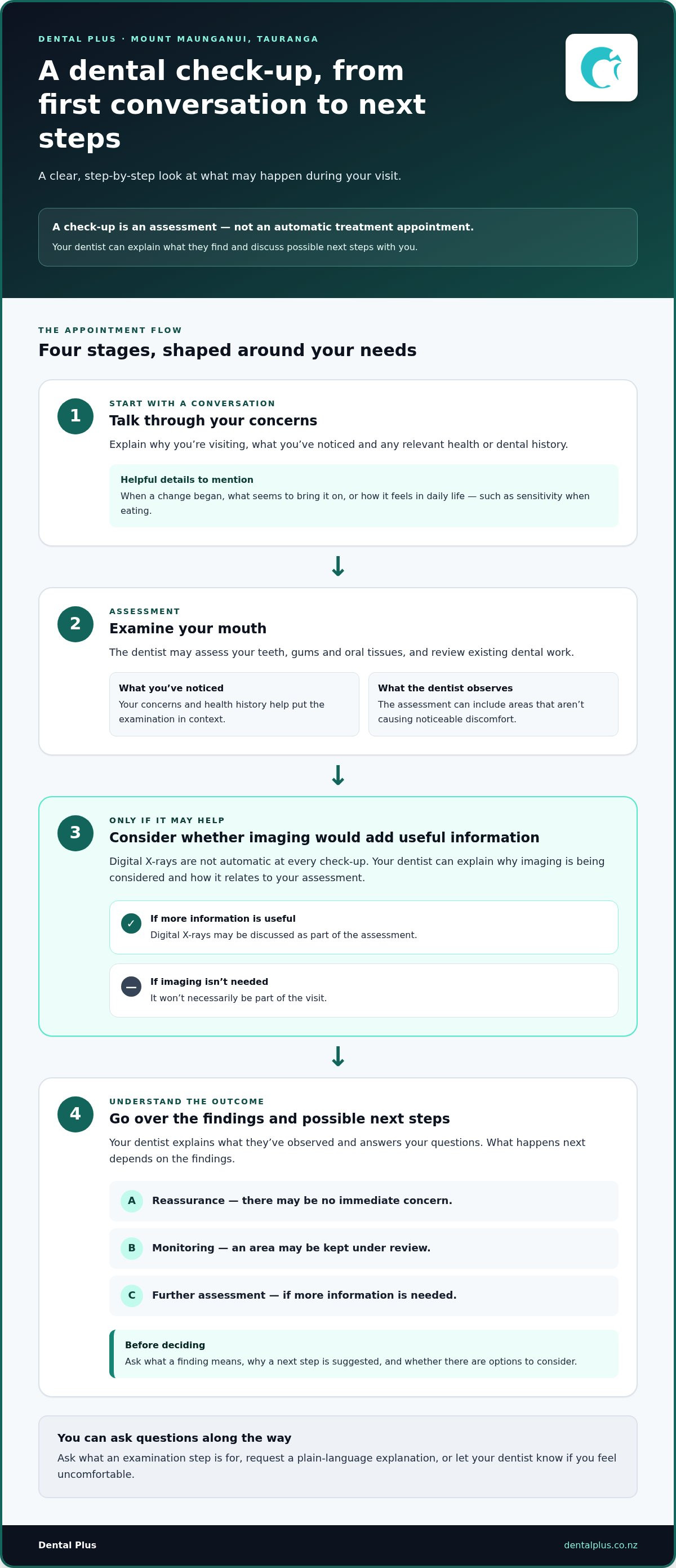
Knowing what to expect at a dental check-up Tauranga can make the appointment feel more familiar before you arrive. Each visit is shaped by your needs, so the order below is a general guide rather than a guaranteed script. Your dentist can explain what they’re doing and make room for questions along the way.
How does the appointment usually begin?
The visit commonly starts with a conversation. You can explain what brought you in, mention any changes or discomfort, and raise the questions you’d like answered. Relevant health and dental history helps the dentist understand your situation and guide the assessment. If you’re unsure what to mention, describe what you’ve noticed in daily life, such as sensitivity when eating or a change around a tooth.
Digital X-rays are considered when they can provide useful information to assess your oral health. They aren’t an automatic part of every check-up. If imaging may help, your dentist can explain why it’s being considered and how it relates to your assessment.
Talk through your concerns. The dentist listens to your reason for visiting and relevant health or dental history. Mention when you first noticed a change and what seems to bring it on, if you know. This helps put the examination in context, whether you have a specific concern or are attending for a routine review.
Examine your mouth. The dentist assesses your teeth, gums and oral tissues, and may review existing dental work. The examination helps build a picture of your oral health, including areas that may not be causing noticeable discomfort.
Discuss whether imaging would help. If further information is useful, digital X-rays may be discussed as part of the assessment. Your dentist can explain why they’re being considered. If imaging isn’t needed for your assessment, it won’t necessarily be part of the visit.
Go over the findings and possible next steps. Your dentist explains what they’ve observed and answers your questions. Depending on the findings, the discussion may involve reassurance, monitoring or further assessment. Ask for clarification before deciding how to proceed.
What might the dentist examine or discuss?
The assessment considers more than the visible surfaces of your teeth. Your dentist may look at your gums and oral tissues, as well as existing fillings, crowns or other dental work. They’ll also consider what you’ve shared about your mouth and general health. This helps make the conversation relevant to you rather than relying on a one-size-fits-all checklist.
It’s fine to pause and ask what an examination step is for, or to say if you feel uncomfortable. Dental Plus provides routine check-ups and digital X-rays at its Mount Maunganui practice, with care tailored to individual needs. You can explore Dental Plus check-ups as you plan your appointment.
What could the dentist find, and what choices come next?
A check-up may leave you with reassurance, a suggestion to monitor an area, or a recommendation for further assessment. The next step depends on what the dentist finds and how it relates to your oral health. If you’re considering what to expect at a dental check-up Tauranga, remember that a recommendation is a starting point for discussion, not a decision you have to make without understanding it.
What if the dentist identifies a concern?
Your dentist can explain what they’ve noticed, where it is and why it may need attention. Sometimes an initial observation needs further assessment before its cause or significance is clear. It’s helpful to distinguish what the dentist has observed so far from what still needs investigating. Ask for a plain-language explanation and take the time you need to understand the proposed next step.
Depending on the finding, your dentist might suggest monitoring an area at a future check-up, gathering more information or discussing care options. These are possibilities, not predictions about what your examination will show. A recommendation should make sense in the context of your needs and the information available.
If you’re unsure, try asking questions such as:
What have you noticed? This can help clarify whether the finding is an observation or whether more assessment is needed.
Why are you recommending this next step? Understanding its purpose can make the decision feel less daunting.
When should I consider following up? Ask about the suggested timing and whether monitoring is an option.
Are there alternatives? If more than one approach may be appropriate, ask the dentist to explain the differences for your situation.
You don’t need to know clinical terms. Describe what you’re worried about or ask the dentist to explain something another way. Clear answers can help you take part in the conversation and remember what was discussed after you leave.
Will I need treatment during the same appointment?
A check-up is an assessment, so treatment isn’t automatic. If the dentist recommends care, make sure you understand what it involves, why it’s being suggested and what choices you have before agreeing to proceed. You can ask for time to consider the information or to have the options explained again.
Aim to leave with a clear understanding of the findings and any agreed follow-up, rather than feeling rushed into a decision. If you’re anxious about a suggested next step, say so. Dental Plus offers personalised care, and sharing your concerns helps the team understand what matters to you.
How can you feel more comfortable and prepared for your check-up?
Preparation doesn’t need to be elaborate. A few notes can help you explain what’s been happening and get more from your conversation with the dentist. If you’re unsure what to expect at a dental check-up Tauranga, remember that it’s fine to arrive with questions, even if you’re not sure how to describe a concern. Your own words are a useful place to start.
What should you bring or mention at your appointment?
Think about anything relevant to your health or dental history that you’d like the dentist to know. You don’t need to prepare a formal account. A short list on your phone or a piece of paper can help you remember details in the appointment, especially if you have several questions or haven’t visited for a while.
Note changes you’ve noticed. For example, mention sensitivity, discomfort, a change in how a tooth feels, or anything unusual you’ve observed. If you can, note when it started and what seems to trigger it.
Share relevant health information. Let the dentist know about health details or changes that may be useful context for your care.
Write down your questions. You might ask what the examination involves, whether imaging could be useful, or what a suggested next step is intended to clarify.
Put your main concern first. If you have a few things to discuss, leading with the one that matters most can help make sure it’s covered.
There’s no need to use clinical language or work out what a symptom means before you come in. Describe what you’ve noticed and when it tends to happen. If a question slips your mind, raise it during the appointment or ask for a point to be explained again.
What can you do if you feel nervous?
Tell the dental team that you’re feeling anxious, either before the examination or when you arrive. You can ask the dentist to explain a step before it happens, check in with you as they go, or pause so you can ask a question. Speaking up helps the team understand what support would make the appointment more manageable for you.
If you’ve had a difficult dental experience before, or you’re worried about a particular part of the visit, sharing that can guide a more personalised conversation. You don’t have to wait until you feel overwhelmed to mention it. Even a simple “I’m a bit nervous” gives the dentist a chance to respond with care and explain what to expect next.
Dental Plus offers sedation as a comfort option to discuss in the context of your individual care. It isn’t needed for every check-up or right for every patient, so raise it as a question if you’d like to understand whether it may be relevant to your situation.
When you’re ready to arrange a visit, explore Dental Plus check-ups at the Mount Maunganui practice.
What are your next steps after a Dental Plus check-up in Tauranga?
Before you leave your appointment, make sure you understand what the dentist found and whether you’ve agreed on any follow-up. That might mean no immediate action was suggested, an area should be monitored, or further assessment was recommended. A finding doesn’t automatically mean you need a procedure or that anything must happen straight away.
How do you make sense of the dentist’s recommendations?
If an explanation feels unclear, ask the dentist to put it in everyday language. Check what they observed, what they recommend next and the reason for that suggestion. If further assessment has been discussed, ask what it would help clarify. Understanding the purpose of a recommendation makes it easier to consider your options and remember what was agreed.
A brief written note can help once you’re back to daily life. Record any suggested follow-up, monitoring advice or self-care guidance, along with questions you want to revisit. If an appointment or check-in was agreed, add it to your calendar. If you’re not sure about the suggested timing, ask the dentist to explain it before you go.
Write down the finding in words that make sense to you.
Note the agreed next step, including whether it’s monitoring or further assessment.
Keep any questions that come up afterwards for your next conversation with the dental team.
These notes are a practical reminder. They don’t mean every observation needs treatment or immediate action. If you leave uncertain about what was discussed, ask for clarification so you can make informed decisions about your care.
How can Tauranga locals take the next step?
For people in Tauranga, Dental Plus provides routine check-ups at its practice in Mount Maunganui. Understanding what to expect at a dental check-up Tauranga can help you feel more at ease about arranging a visit and taking part in the conversation. The appointment is an opportunity to review your oral health and discuss next steps that relate to your needs.
For more information about preventive care and what an examination may involve, read the routine dental exam guide. It can help you think of questions to raise at your check-up.
Whether you’re returning for a routine review or arranging a visit after some time away, take it one step at a time. Book a routine check-up with Dental Plus in Mount Maunganui, Tauranga, and discuss your oral health in a personalised setting.
Take the next step towards feeling confident about your oral health
You don’t need to have every question answered before arranging a check-up. Start with what’s on your mind and use the appointment to build a clearer understanding of your oral health. Knowing what to expect at a dental check-up Tauranga can make that first step feel more manageable, and you can ask for explanations along the way.
If you’ve been putting off a visit because you’re unsure what might happen, note your main concern and bring it to your appointment. A straightforward conversation can help you understand what’s relevant to your situation and consider any follow-up with greater confidence.
Dental Plus provides routine dental care in Mount Maunganui. Book a dental check-up with Dental Plus to discuss your oral health and take a considered step towards looking after your smile.
Frequently Asked Questions
How often should I book a dental check-up?
The right interval depends on your oral health and circumstances, so follow the timing your dentist recommends rather than assuming everyone needs the same schedule. At the end of your visit, ask when they suggest you return and what that timing is based on. If you’ve been given a review timeframe, add a reminder to your calendar. Your dentist can revisit the interval as your needs change.
Can I have a dental check-up if I do not have tooth pain?
Yes, you can book a check-up without tooth pain. An examination can review your oral health even when nothing feels wrong, and it gives you a chance to raise questions about changes you’ve noticed. Pain isn’t the only reason to seek an assessment. If you’re researching what to expect at a dental check-up Tauranga patients attend, remember that a routine visit can be useful even when you feel well.
Is a dental check-up painful?
A check-up is an assessment, and the examination shouldn’t be assumed to involve pain. You may notice some pressure or sensitivity, particularly if an area is already tender, but experiences vary. Let the dentist know if something feels uncomfortable, and ask them to pause or explain what they’re doing. Mentioning sensitive teeth or past discomfort beforehand helps the team understand what you’re concerned about.
Can I ask the dentist to explain each step during my check-up?
Yes. You can ask for an explanation before or during any part of the examination. Try questions such as, “What are you checking here?” or “Can you tell me why you’re suggesting that?” If you prefer to know what’s coming before the dentist begins, say so at the start. You can also ask for a short pause if you need time to process information or collect your thoughts.
What should I do if I have not had a dental check-up for years?
Book a routine check-up and tell the dental team it’s been a while. There’s no need to apologise or know what care you might need before you arrive. If you’ve noticed anything different, such as sensitivity or discomfort, mention it when you book or at the appointment. The dentist can assess your current oral health and talk through any relevant next steps with you.
Can I eat before a routine dental check-up?
For a routine check-up, you can generally eat as you normally would beforehand; fasting isn’t usually part of a standard examination. Brushing your teeth before you leave may help you feel fresh, but don’t worry if you can’t. If your visit includes sedation or you’ve been given specific preparation instructions, follow the guidance provided for your appointment rather than relying on general advice.
What happens if I need a follow-up after my check-up?
Your dentist will explain the reason for any suggested follow-up and what it’s intended to address. It may involve monitoring an area or arranging further assessment; it doesn’t automatically mean you need treatment. Before you leave, make sure you understand the recommended timing and write down the plan. If you’re unsure what to do next, ask the dental team to clarify the steps and any advice to remember.


Comments