
Stop Feeling Self-Conscious About My Teeth and Smile

Your teeth don’t have to feel perfect before you let yourself smile. To stop feeling self-conscious about your teeth, start by identifying what bothers you most, then consider whether practical dental care or small changes to how you approach social situations could help. Practising a relaxed smile for 3-5 minutes daily can also help you feel more at ease with smiling.
It’s understandable to feel exposed when you’re worried about the colour, shape or alignment of your teeth. You might cover your mouth, avoid photos or wonder whether other people notice what you notice. Those feelings are real, but they don’t have to define every conversation or keep you from enjoying a smile.
This article explores how cosmetic dental treatments, social situations and smiling can affect confidence, and how to consider options that may suit your concerns. You’ll also learn why a personalised dental care plan can be a useful starting point, whether you’re considering a change to your teeth or simply hoping to feel more comfortable showing them.
Table of Contents
Cosmetic dentistry, tooth replacement and braces
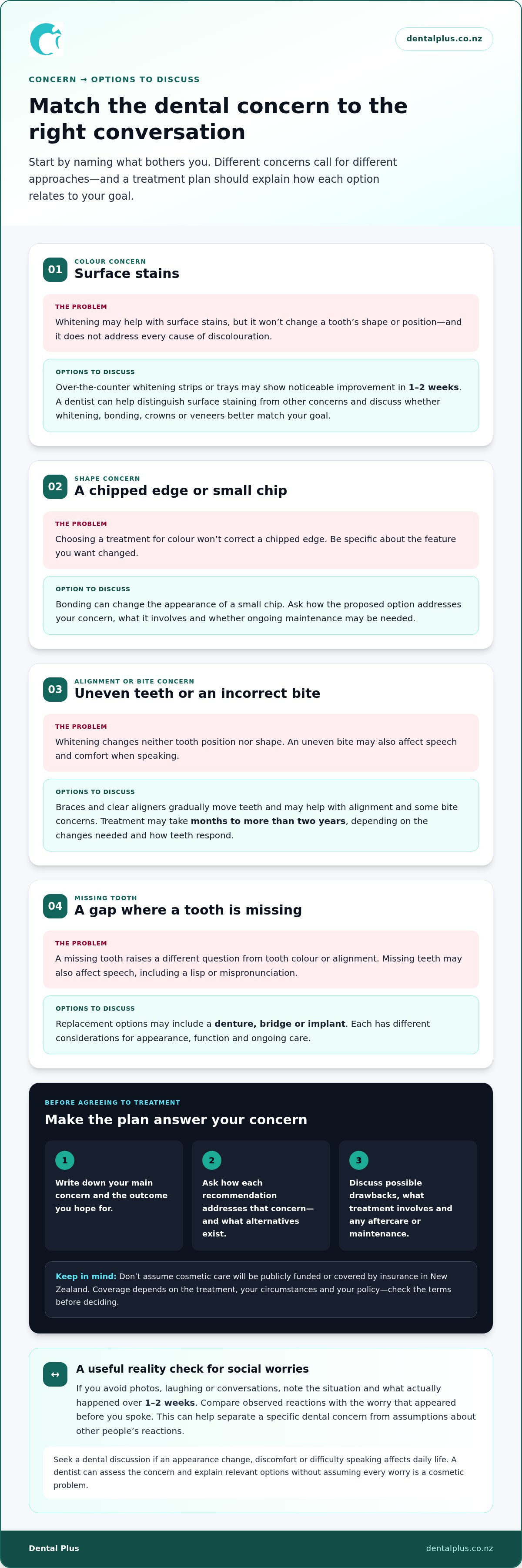
A useful first step is to name the concern: tooth colour, a chipped edge, a gap, a missing tooth or an uneven bite. Different concerns call for different approaches, so cosmetic treatment starts with understanding what you want to change and what may affect oral function. For example, whitening may address surface stains, while bonding can change the appearance of a small chip. A treatment plan should explain how each proposed option relates to your concern.
Are cosmetic dental treatments covered by insurance or publicly funded in New Zealand? Don’t assume cosmetic care will be publicly funded or covered by insurance. Coverage depends on the treatment, your circumstances and your insurance policy, so understand the terms before making a decision.
For surface stains, over-the-counter whitening strips or trays may show noticeable improvement in 1-2 weeks. Whitening does not address every cause of discolouration, and it won’t change the shape or position of a tooth. A dentist can help distinguish surface staining from other concerns and explain whether whitening, bonding, crowns or veneers better matches your goal. The distinction matters: choosing a treatment for colour won’t correct a chipped edge or an irregular bite.
Braces and clear aligners gradually move teeth, which can help with alignment and some bite concerns. Treatment may take months to more than two years, depending on the changes needed and how teeth respond. Missing teeth raise a different question: replacement options may include a denture, bridge or implant, each with different considerations for appearance, function and ongoing care. Missing teeth or an incorrect bite may also affect speech, including a lisp or mispronunciation. These effects can make speaking feel uncomfortable, as well as affect how you feel about smiling.
How do I find a trustworthy dentist in New Zealand for cosmetic dental concerns? Look for a dentist who explains the reason for each recommendation, the alternatives, possible drawbacks and aftercare. A clear discussion should connect the proposed treatment to your priorities, such as changing a visible gap rather than altering otherwise healthy teeth.
Before agreeing to treatment, write down your main concern and the outcome you hope for. Then ask how each suggested option would address it, what it involves and what maintenance may be needed. For instance, someone concerned about one chipped tooth may want to compare a conservative repair with a more extensive change. Understanding the difference helps you weigh appearance, function and the amount of treatment involved.
A measured plan can make the decision feel more manageable. You don’t have to choose the most extensive option to make a meaningful change. Start with the concern that matters most to you. Whether the focus is whitening, alignment or replacing a missing tooth, clarity about your goal helps you decide what to discuss next.
Dental appearance in social situations
A chipped tooth, visible gap or concern about colour can change how you act in a conversation. Notice what you avoid, such as photos or laughing with friends, to identify the situations that feel hardest.
Dental appearance and confidence
Dental appearance and confidence are connected when worries about teeth influence how freely someone speaks, smiles or joins in. For example, a person who hides a chipped tooth may focus on their mouth instead of a conversation. Recognising that pattern matters because it separates a specific concern from the assumption that everyone else is judging it. Tracking social interactions for 1-2 weeks can help compare those assumptions with what actually happens.
Reasons for feeling embarrassed about teeth
Embarrassment can stem from a visible feature, a past comment or the fear that others will notice something you already worry about. A gap, staining or uneven teeth may feel especially prominent during a close conversation or group photo. Naming the trigger helps clarify whether you want dental advice, support with self-conscious thoughts, or both. It also keeps one feature from defining your whole appearance.
Feeling more comfortable in social situations
Feeling more comfortable means taking part in conversations without letting worry dictate every expression. If you’re anxious about talking, smiling or laughing, focus on the person speaking and let your face respond naturally rather than holding a fixed smile. At a gathering, try joining one conversation before deciding how you feel about the whole event.
For a practical reality check, note the situation and what happened over 1-2 weeks. Record whether anyone actually commented on your teeth, or whether the worry appeared before you spoke. This isn’t about dismissing your feelings; it helps distinguish observed reactions from predictions. At home, gentle brushing with fluoride toothpaste and cleaning between teeth can support a tidy appearance. Avoid household chemicals or harsh abrasives on teeth, as they can cause harm.
When to seek professional support
Discuss your concern with a dentist when a change in appearance, discomfort or difficulty speaking affects daily life. Describe the feature that troubles you and the situations where you notice it. A dental assessment can help identify a practical concern and explain relevant options, rather than treating every worry as a cosmetic problem.
Consider speaking with a mental health professional if fear of judgement leads you to avoid friends, photos or everyday conversations. For example, repeatedly cancelling plans because of your smile can affect wellbeing beyond dental appearance. You can seek support for deeper emotional concerns—such as through specialised psychotherapy practices like Dialogs with Life, Inc.—while also discussing a specific tooth concern with a dentist. Both conversations can help you make choices based on your needs, not pressure to look perfect.
Smiling and happiness
A smile can express enjoyment, warmth or amusement, but it doesn’t have to look perfect to be genuine. If you’re self-conscious about your teeth, you might hold back during a funny story or cover your mouth in a photo. Separating the moment’s enjoyment from worries about appearance can help you notice what you want to take part in, even as confidence grows.
Smiling practice is a small way to become more familiar with your own expression. Try a relaxed smile for five minutes each day over seven days, using the suggested 7-day routine. Choose a quiet moment, such as after breakfast, and let your jaw and cheeks settle rather than forcing a broad grin. The aim is comfort with the movement, not a particular look.
Keep the practice ordinary. For example, smile gently while greeting someone at home, then notice whether your expression feels tense or natural. If it feels strained, relax your face and try again later. A mirror can help you notice the difference between a held grin and a comfortable expression, but it isn’t a test of whether your smile looks attractive.
Smiling isn’t a requirement for happiness, and you can enjoy a moment without showing your teeth. At a family dinner, you might feel pleased while listening, even if you choose a closed-mouth smile. Allowing that range can reduce pressure to perform a particular expression. You can laugh, speak or simply enjoy the company in ways that feel natural to you.
It can also help to notice what you value in a moment beyond a photograph. During a catch-up with a friend, focus on the story, the shared joke or the feeling of being included. This shifts attention to the interaction itself, rather than repeatedly checking how your teeth appear. You don’t have to ignore a dental concern; you’re making room for the present moment too.
After the seven-day practice, reflect on what changed in your comfort, not on whether your teeth look different. Did a relaxed smile feel easier during a greeting? Could you laugh at a joke without immediately hiding your mouth? Specific observations are more useful than judging yourself against an idealised photo or someone else’s expression.
If a particular dental feature continues to occupy your attention, write down what you’d like to understand about it. For example, distinguish a concern about tooth colour from discomfort with smiling in photos. That distinction can make a future conversation about your teeth more focused, while leaving room for happiness and connection in everyday life.
How can I feel less self-conscious about my teeth?
Start by separating a specific dental concern from the wider belief that your smile defines you. Write down the feature you notice, such as staining, a gap or an uneven edge, then name one situation where it affects you. This clarifies the concern and gives you a practical starting point, rather than trying to change everything about your appearance at once.
Practise a relaxed smile for 3-5 minutes daily. Choose an ordinary moment, such as greeting someone at home, and let your expression settle without aiming for a perfect grin. Notice whether your jaw feels tense or your smile feels more comfortable. The purpose is to get used to smiling, not to grade your teeth in the mirror or force an expression that doesn’t feel like you.
When thoughts about your teeth interrupt a conversation, redirect your attention to one detail about the person speaking. Listen for the point they’re making or ask a follow-up question. At a café, for example, focus on enjoying the conversation rather than monitoring how your mouth looks. This doesn’t dismiss a concern; it makes room for the interaction alongside it.
For a concrete next step, book a dental check-up within 2-4 weeks and describe what concerns you. A clear treatment plan can help distinguish appearance preferences from issues that may need dental attention. Ask how each suggested option relates to your concern and what the plan aims to change. Knowing the purpose of a recommendation can make decisions feel more manageable.
Keep your goal personal and specific. Instead of aiming for a flawless smile, you might want to feel comfortable laughing with friends or speaking in a meeting. A dental care plan can address appearance concerns while helping you focus on reasons beyond appearance. That could mean choosing a small change or deciding that your priority is participating more freely in everyday moments.
Review your progress by noticing your actions, not judging your reflection. For instance, record when you joined a conversation, smiled at a friend or stayed in a photo without covering your mouth. These examples show where confidence is growing, even if your teeth haven’t changed. If a dental feature remains your main concern, bring that specific example to your appointment and discuss what may help.
There’s no need to wait until every worry disappears before taking part in life. Keep your daily smile practice simple, make a clear note about your concern and use your check-up to understand relevant options. These steps can help you stop feeling self-conscious about your teeth while keeping your attention on the people and experiences that matter to you.
What causes people to feel embarrassed about their teeth?
Embarrassment can begin with a visible feature, but its meaning often grows through experience. Someone may notice one discoloured tooth in a photo, then assume it dominates every conversation. A friend’s comment or a past experience at school can make the concern feel more significant. Identifying the trigger helps separate what you can observe from what you fear others might think.
Comparisons about appearance can sharpen that focus. Social media photos, professional portraits and edited images often use carefully chosen angles and lighting. Comparing your everyday smile with a polished image can make normal differences feel like faults. For example, you might fixate on a small gap after seeing a filtered photo, even though it rarely affects how you speak or eat. The comparison, rather than the gap alone, may be fuelling distress.
Past remarks can also shape how someone sees their teeth. A teasing comment about braces or a chipped edge may come back to mind before a group photo years later. In that moment, the old remark can feel like evidence that others are still judging you. Ask yourself what happened today, rather than treating a remembered comment as proof of what everyone currently thinks.
Some concerns relate to a change in appearance or function. A newly chipped tooth, discomfort when chewing or difficulty pronouncing a word can draw attention to the mouth. These experiences differ from disliking a feature in a photograph, so note what changed and when. For instance, record whether the concern appears only in photos or also affects eating, speaking or daily care. That distinction can guide a useful conversation with a dentist.
Attention can become fixed on one detail. Checking the same tooth in several mirrors, repeatedly zooming in on selfies or avoiding every camera can keep the worry prominent. Try replacing one checking habit with a specific action: take a photo once, then put your phone away and return to the activity. Notice whether the worry eases when your attention shifts to a conversation, meal or shared joke.
Embarrassment may also combine several causes, such as a past comment, comparison with edited images and worry about a visible gap. Naming each influence makes the concern easier to describe without blaming yourself. If a specific dental change troubles you, you can discuss your dental concern and explain what you’ve noticed. A clear example, such as discomfort while eating, gives that conversation a practical starting point.
Dental Plus: Professional Dental Hygiene
Dental Plus can help you explore practical next steps when concerns about your teeth affect your confidence. Professional Dental Hygiene supports ongoing oral care, while a Routine Check Up gives you the opportunity to discuss a specific concern and understand what may be contributing to it. Digital X-Rays can support an assessment when imaging is appropriate. If you’re considering a cosmetic change, Digital Smile Design (DSD) can help you discuss your smile goals and treatment options.
You don’t need to arrive with a decision made. Bring a clear example of what concerns you, such as a feature you notice in photos or a change you’ve observed. Contact Dental Plus to discuss a suitable next step.
Take the next step at your own pace
Confidence doesn’t have to wait until you’ve made every decision about your smile. Start by choosing what matters most to you: feeling more relaxed in photos, speaking comfortably or understanding a particular dental concern. That gives your next conversation a clear focus, without making appearance the measure of your worth.
If your goal is to stop feeling self-conscious about your teeth, treat progress as a series of personal choices rather than a demand for perfection. You might want to explore care, talk through a concern or take more part in moments you’ve been avoiding. Each is a meaningful step when it reflects what you need.
When you’re ready to discuss your options, contact Dental Plus to discuss your options. You can start with the concern that feels most important and take the conversation from there. Your smile is yours, and you can move forward in a way that feels right for you.
Frequently Asked Questions
What dental treatments can improve stained, crooked, chipped, or missing teeth?
Suitable treatment depends on the concern and the condition of the teeth involved. Whitening may address staining, while bonding can reshape a chipped edge. Braces or clear aligners address alignment concerns. Crowns or veneers may change a tooth’s appearance, and a dentist can discuss replacement options for missing teeth. For example, a single chipped tooth calls for a different discussion from several crooked teeth.
How much do teeth whitening, braces, veneers, and dental bonding cost in New Zealand?
The price depends on your case and is given after a quote request. Cost factors include the treatment selected, how many teeth are involved, the complexity of the work and any planning or follow-up required. For instance, whitening and bonding involve different procedures, while braces involve a treatment plan over time. Ask for an itemised outline so you can understand what the proposed care includes before deciding.
What are the risks and long-term effects of veneers, whitening, and orthodontic treatment?
Each option has different considerations. Whitening may cause temporary sensitivity, veneers can involve lasting changes to natural tooth structure, and orthodontic treatment may bring discomfort as teeth move. After braces or aligners, maintaining the result can involve ongoing retention. Oral hygiene and routine dental care also matter during treatment. Discuss possible effects, maintenance needs and alternatives for your teeth before choosing an approach.


Comments