
Non-invasive cosmetic dentistry: gentler ways to enhance your smile

What if improving your smile didn’t have to mean changing healthy teeth more than necessary? It’s a reasonable concern: cosmetic treatments differ in how much they alter natural tooth structure, and “non-invasive” doesn’t always mean the same thing as “minimally invasive”. Understanding the distinction can help you feel more confident when exploring non-invasive cosmetic dentistry.
This guide explains what non-invasive cosmetic dentistry can involve and how common choices compare. You’ll learn how whitening, bonding, veneers and aligners address different concerns, and what to consider about their potential effects on your teeth. A conservative smile plan starts with what you’d like to change, then considers the treatment that best fits that goal.
If you’re exploring options in Tauranga, a conversation with a dentist can bring your dental health and smile goals into the same plan. At Dental Plus in Mount Maunganui, you can discuss whitening, dental bonding and veneers with the dental team, and consider Digital Smile Design as an optional preview tool. The following sections will help you understand the choices and prepare questions for a considered, personalised approach.
Table of Contents
What does non-invasive cosmetic dentistry mean for your natural teeth?
Wanting to brighten or refine your smile while keeping healthy natural teeth intact is a sensible place to start. The phrase non-invasive cosmetic dentistry generally describes care that doesn’t surgically alter or remove tooth structure. It refers to the level of intervention, rather than guaranteeing a particular result or promising that every option leaves teeth completely untouched.
Cosmetic dentistry covers treatments aimed at changing the appearance of teeth, with different approaches suited to different concerns. The Cosmetic Dentistry Overview provides general background on this area. For your own smile, the useful questions are more specific: what change are you hoping for, and what would the proposed treatment involve for your teeth?
Non-invasive and minimally invasive are not always the same
These terms describe different degrees of intervention, but they can be used loosely. “Non-invasive” suggests that treatment doesn’t surgically alter or remove tooth structure. “Minimally invasive” allows for some intervention while aiming to limit changes to natural teeth. Neither term, by itself, guarantees comfort, reversibility or a particular outcome.
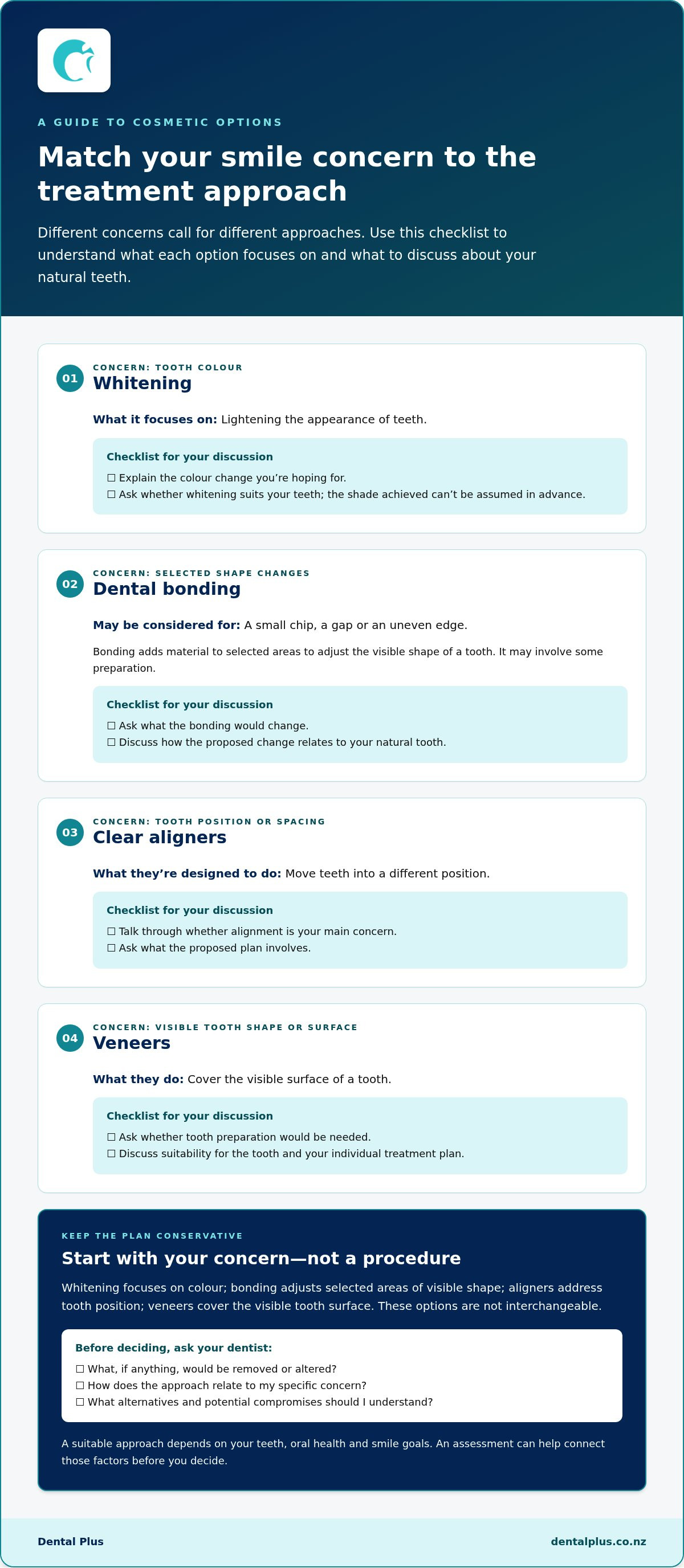
The approach depends on the tooth and the concern. Whitening focuses on colour, while bonding adds material to selected areas and may involve some preparation. Veneers and crowns aren’t automatically non-invasive: whether a tooth needs preparation depends on the treatment plan. Before deciding, ask your dentist to explain what would be changed and why.
Why preserving natural tooth structure matters
A conservative discussion starts by looking at the condition of your teeth, not by assuming you need a particular cosmetic procedure. Your dentist can assess your oral health, listen to what you’d like to change and discuss suitable options. If your concern relates to colour, shape, spacing or alignment, the appropriate approach may differ, and the effect on natural teeth is part of that conversation.
Conservative cosmetic dentistry means choosing an approach that addresses your concern while preserving as much healthy natural tooth structure as practical.
That doesn’t mean the least involved option is always the right one. Existing dental concerns may affect what can reasonably be considered, and a cosmetic goal may have more than one possible approach. An assessment helps connect the treatment to both your smile goals and dental health, so you can understand the choices before proceeding.
Ask what, if anything, would be removed or altered.
Discuss how the proposed approach relates to your specific concern.
Take time to understand the alternatives and their potential compromises.
Clear answers make the distinction between non-invasive and minimally invasive care easier to understand. They also keep the plan focused on what matters to you, rather than on a procedure chosen before your teeth and goals have been considered.
Which non-invasive cosmetic dentistry options address different smile concerns?
The right option depends on what you’d like to change. Tooth colour, a small chip and crowded teeth are different concerns, so the treatments that address them aren’t interchangeable. This comparison can help you prepare for a conversation about non-invasive cosmetic dentistry and understand where an option may involve changes to natural teeth.
Whitening and bonding for colour or small shape changes
Whitening may suit someone whose main concern is tooth colour, but the shade achieved can’t be assumed in advance. Bonding may be considered for selected shape concerns, such as a small chip, a gap or an uneven edge. It adds material to the tooth, so discuss the proposed change and how it may affect the natural tooth. Dental Plus offers smile whitening and dental bonding.
These options address different things: whitening focuses on colour, while bonding adjusts selected areas of visible shape. If you’re weighing bonding against veneers, this guide to dental bonding versus veneers in Tauranga outlines some of the differences in purpose and approach.
Aligners and veneers: different goals, different approaches
Clear aligners address tooth position; veneers change the visible tooth surface. Dental Plus offers adult and teen clear aligners, as well as Invisalign First® for ages 7 to 10. Veneers may involve preparing a tooth, but the amount and suitability depend on the individual treatment plan. The American Academy of Cosmetic Dentistry provides broader information about cosmetic dentistry, while your dentist can discuss how an option applies to your teeth and goals.
Dental Plus offers whitening, bonding and veneers, with Digital Smile Design available as an optional preview tool. It can support discussion about a possible smile plan, but it isn’t a required step or a guarantee of the final result. For a personalised comparison of your options, explore cosmetic dentistry with Dental Plus in Mount Maunganui.
Does non-invasive cosmetic dentistry mean no trade-offs?
Choosing an option described as gentle or conservative doesn’t mean it will be completely non-invasive, reversible or suited to every concern. The phrase non-invasive cosmetic dentistry can describe an approach, but it doesn’t replace a discussion of what treatment involves for your particular teeth. Some changes may be limited; others may involve altering tooth structure. Your dentist can explain the proposed approach after assessing your oral health and goals.
Cosmetic treatment is a personal choice, not a requirement. You may decide that a concern doesn’t need treatment, or that the available approaches don’t feel right for you. A useful discussion weighs what an option may address against its limitations, so you can make an informed decision without assuming that the most involved treatment is automatically best.
When a conservative option may not address the whole concern
Treatments are designed for different aims. Whitening changes tooth colour, but it won’t reposition teeth or reshape their edges. Bonding may adjust selected areas of visible shape, while veneers cover the visible tooth surface. These treatments aren’t interchangeable in every case, and suitability depends on your teeth and the change you’re hoping to make.
Before considering treatment, describe your main concern in practical terms. Is it the colour, the position of a tooth, a chipped edge or the appearance of its surface? Share what you’d like to see change, as well as what you’d prefer to preserve. This gives your dentist a clearer basis for discussing options and any compromises involved.
Which part of my smile is bothering me most?
What would this option change, and what would it leave unchanged?
Are there alternatives that address my priority differently?
What should I understand about the effect on my natural teeth?
What to understand before considering veneers
Veneers can change the visible surface of a tooth, but preparation isn’t identical for everyone. Whether preparation is recommended, and what it would involve, depends on the individual treatment plan. Don’t assume that every veneer is “no-prep”, or that tooth alteration is always required. Ask your dentist to explain the plan for your teeth, including the reason for any preparation.
It can also help to clarify what the veneer is intended to address and how that differs from bonding or another option. A broader comparison of crowns and veneers in Tauranga can help you understand how these treatments differ, while an assessment puts those general distinctions in context for your smile.
There’s no need to settle on a procedure before you’ve had that conversation. A considered treatment plan starts with your concern, takes your dental health into account and explains the possible benefits and trade-offs. You can then decide whether to proceed, explore another approach or leave your smile as it is.
How can you prepare for a conservative smile consultation in Tauranga?
A little preparation can make it easier to explain what you’d like to change and understand how different options fit your goals. For a conversation about non-invasive cosmetic dentistry, focus first on your main concern, then consider how it relates to your oral health and the choices available. You don’t need to know the name of a treatment before your appointment.
Identify your priority. Is it tooth colour, shape, spacing or alignment? If you have more than one concern, decide which matters most to you.
Describe your goal. Use everyday language to explain what you hope will look different, and what you’d prefer to keep as it is.
Review your oral health. Your dentist can assess your teeth and discuss how their current condition may affect suitable cosmetic options.
Compare approaches. Talk through what each option may change, what it preserves and any limitations that matter to your decision.
Questions to take to your dental appointment
It’s fine to bring a short list. Clear questions can help you understand the plan without feeling you need to decide on the spot. Ask what a recommended option changes, whether it involves altering natural tooth structure, and how your oral health affects the recommendation.
Could a less invasive option address the same concern?
What alternatives are suitable for my teeth and goals?
What are the limitations or compromises of each option?
What would happen if I chose not to treat this concern?
These questions invite a balanced discussion. A dentist can explain why an option is being considered and how it relates to your priorities. If the proposed approach isn’t clear, ask for the steps to be explained in plain language before making a decision.
Bring your goals into the treatment conversation
Describe the change you want in your own words. For instance, you might say that one edge looks uneven in photos, or that you’d like to discuss the colour of your teeth. A simple list of concerns can help keep the conversation focused. If you have photographs that show what you mean, you can bring them as discussion points, not as a promise of a particular result.
At Dental Plus, Digital Smile Design is an optional preview tool that can support a conversation about possible smile changes. It isn’t required, and a preview doesn’t guarantee the final outcome. Your dentist can explain how it may fit into planning alongside an assessment of your teeth and your preferences.
Arriving with a clear priority and a few questions gives you a practical starting point, while leaving room to consider options together. Dental Plus provides cosmetic dentistry in Tauranga, including at its Mount Maunganui practice.
Explore cosmetic dentistry options with Dental Plus in Mount Maunganui
Choosing a smile treatment starts with understanding what matters to you and how your dental health shapes the available options. At Dental Plus, you can discuss smile whitening, dental bonding and veneers with the local team, considering each option in relation to your goals. Digital Smile Design is also available as an optional preview tool, not a required step or a promise of a particular result.
Dental Plus has more than 30 years of experience and a team of three specialised dentists and 13 staff members. The practice offers general and cosmetic dentistry, giving patients the opportunity to discuss appearance goals alongside their dental health. If you’re exploring non-invasive cosmetic dentistry, the team can explain what different approaches may involve, while an assessment helps inform which options could be suitable for you.
What patients can expect from a personalised discussion
A useful conversation begins with your concerns. You might want to talk about tooth colour, the shape of an edge, or another feature that affects how you feel about your smile. The dental team can consider your goals alongside the condition of your teeth and discuss possible smile enhancement options in that context.
Every option has its own purpose and may involve different considerations. You can ask what a suggested treatment is intended to change, whether it may affect natural tooth structure, and what alternatives could address your concern. The aim is to help you understand the choices, not to assume that every treatment suits every person.
Digital Smile Design can be used as an optional preview tool to support planning and discussion. It may help you visualise a proposed direction, but it doesn’t guarantee the final result and isn’t necessary for every treatment plan. Your dentist can explain how it fits, if appropriate, into a conversation about your priorities.
Taking the next step at the Tauranga practice
Before getting in touch, it may help to note your main concern and the questions you’d like answered. You could write down whether colour, shape, spacing or alignment is your priority, and what you’d like to preserve. That gives you a straightforward starting point for discussing cosmetic options and your dental health with the team.
Dental Plus is at 41 Girven Road, Mount Maunganui, Tauranga, NZ 3116. You can book through the website or call the practice to arrange an appointment. A conversation can help you explore suitable options without committing to a particular treatment or outcome.
Book an appointment with Dental Plus to discuss your smile goals with the Mount Maunganui team.
Take the next step at your own pace
You don’t need to arrive with a treatment already in mind. A useful next step is simply to bring one clear question: what would help me feel more comfortable with my smile while respecting my dental health? That question can guide a thoughtful conversation and help you weigh whether any change feels right for you.
Exploring non-invasive cosmetic dentistry is about understanding your choices, not committing to a procedure. Take time to talk through your priorities, consider the options and decide what feels appropriate. If you’re still unsure, that’s a valid place to start too. The right plan is one you understand and feel comfortable considering.
Dental Plus welcomes you to discuss your smile goals with the team in Mount Maunganui. Book an appointment to discuss your smile goals and take a considered first step towards a plan that feels right for you.
Frequently Asked Questions
Is non-invasive cosmetic dentistry completely pain-free?
No dental treatment can be promised to be completely pain-free for everyone. Sensations vary depending on the procedure, your teeth and your personal sensitivity. Even a treatment that doesn’t remove tooth structure may still feel uncomfortable for some people. Before starting, tell your dentist about past experiences or sensitivity and ask what to expect during and after the proposed treatment. This helps the team discuss your comfort and care needs.
Can teeth whitening change the colour of crowns or fillings?
No, whitening changes the colour of natural teeth, but it doesn’t lighten the material used in crowns or fillings. If you have visible restorations, whitening could leave a difference between their shade and the surrounding teeth. Mention any crowns or fillings during your assessment, especially if they’re near the front of your mouth. Your dentist can discuss how they may affect your options and the overall appearance you’re hoping for.
Can dental bonding stain over time?
Bonding material can become stained or change in appearance over time, although the way it looks can depend on factors such as the material, its location and your habits. If you drink tea, coffee or other strongly coloured drinks often, mention this when discussing bonding. Ask how to care for the bonded area and what to do if you notice a change. Your dentist can advise based on your treatment and oral health.
Can cosmetic dentistry be considered if I have untreated dental problems?
It may be possible to discuss cosmetic goals, but untreated dental concerns should be part of the assessment before a cosmetic plan is decided. For example, tell your dentist about tooth pain, bleeding gums or a damaged filling, rather than focusing only on appearance. Your oral health can affect which options are appropriate and when they’re considered. The dentist can explain whether any dental care should be addressed as part of planning.
Can I choose cosmetic dental treatment without using Digital Smile Design?
Yes. Digital Smile Design is optional, so you can discuss cosmetic treatment without using it. You can explain what you’d like to change and ask your dentist to talk through the options verbally. If a visual preview would help you consider a plan, you can discuss whether Digital Smile Design may be useful. It’s a planning aid, not a requirement or a guarantee of the final appearance.
Does non-invasive cosmetic dentistry include clear aligners?
Clear aligners may be considered as part of a smile plan when tooth positioning is the concern, but they work by moving teeth, so they aren’t a treatment that leaves everything unchanged. Dental Plus offers adult and teen clear aligners, as well as Invisalign First® for ages 7 to 10. A dentist can assess your teeth and discuss whether aligners relate to your goals, along with what the treatment involves.
Can cosmetic treatments be combined in one smile plan?
Yes, a dentist may discuss a plan involving more than one treatment, depending on your oral health, priorities and the options suited to your teeth. For instance, someone concerned about both tooth colour and a chipped edge could ask how whitening and bonding might fit together. The order and suitability need individual assessment, and combining treatments doesn’t guarantee a particular result. Ask what each step is intended to address and whether every step is needed.


Comments