
Braces Trays: The Complete Guide to Clear Aligners and Modern Orthodontics

A slim sleeve of clear medical plastic looks far too gentle to shift teeth, yet modern braces trays deliver the exact same calibrated orthodontic force as traditional stainless steel brackets. Rather than acting as passive cosmetic covers, these custom appliances use microscopic, sequential pressure to guide misaligned teeth into position without drawing unwanted attention.
If you're hesitant about wearing noticeable metal hardware in professional settings, or confused by overlapping labels like aligners, clear trays, and retainers, you're not alone. It's completely natural to wonder whether a removable option can truly correct complex crowding or bite alignment without painful disruptions to your daily routine.
Here, you'll discover how clear braces trays safely transform your teeth, compare their day-to-day comfort with fixed braces, and learn how tailored treatment planning protects your long-term oral health. We break down the clinical science, daily maintenance habits, and suitability considerations so you can choose your orthodontic pathway with total confidence.
Table of Contents
What Are Braces Trays and How Do Clear Aligners Work?
Orthodontic braces trays are custom-engineered, transparent appliances designed to realign teeth through calibrated biomechanical force. Often referred to broadly as clear aligners, these systems provide a discreet alternative to conventional fixed brackets. Rather than relying on archwires bonded to your enamel, treatment relies on a progressive series of precision-crafted sleeves that fit snugly over your dental arches.
Modern aligners are pressed from multi-layered medical thermoplastics. These advanced polymers exert gentle, continuous tension against targeted teeth, stimulating cellular bone remodelling without causing excessive trauma to delicate oral tissues.
Active Movement Trays Versus Passive Retainers
It is easy to confuse aligner trays with retainers, nightguards, or teeth-whitening trays because they look almost identical on the surface. However, their underlying biomechanics serve entirely opposite functions:
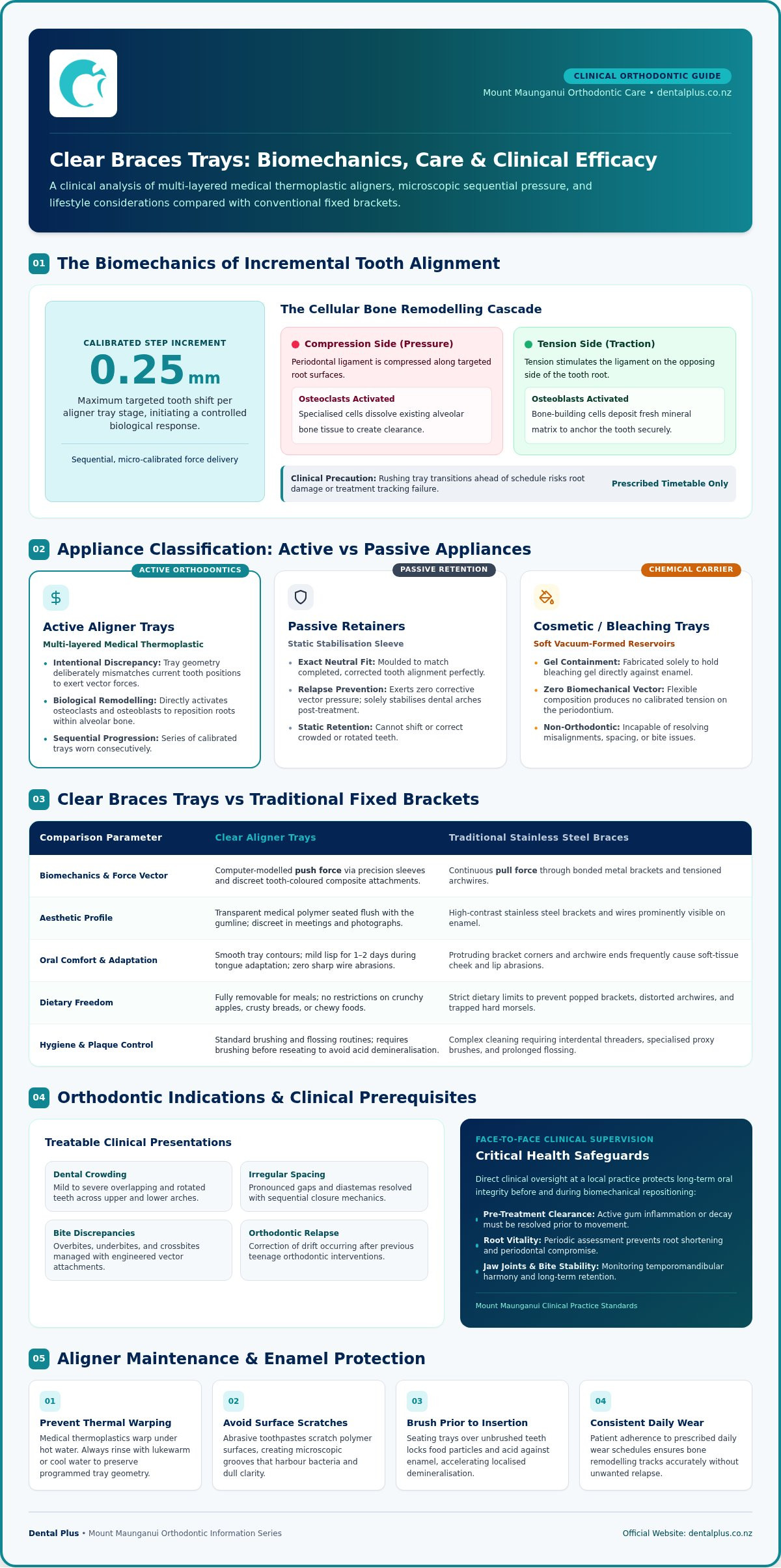
Active aligner trays: Engineered with intentional discrepancies between your current tooth positions and the tray geometry. This mismatch generates specific vector forces that actively remodel alveolar bone.
Passive retainers: Molded to match your finished tooth alignment perfectly. Their sole purpose is structural stability, preventing natural relapse after tooth movement ends.
Cosmetic trays: Soft, vacuum-formed guards made solely to hold bleaching gel against enamel, delivering zero corrective movement.
Wearing an old retainer or a generic bleaching tray will never correct crowded teeth. True dental correction demands an engineered sequence of active movement stages.
The Biomechanics of Incremental Tooth Alignment
Each set of aligners gently shifts target teeth by up to 0.25 millimetres. While that movement sounds tiny, it triggers a sophisticated biological cascade beneath your gumline. Pressure compresses the periodontal ligament on one side of the root, prompting osteoclasts to dissolve bone tissue. On the tension side, osteoblasts generate fresh bone cells to anchor the tooth securely in its new position.
Switching your braces trays strictly according to your clinician's timetable is vital. Rushing forward before surrounding bone has had time to rebuild can lead to root damage or treatment tracking failure.
Who Makes a Prime Candidate for Orthodontic Trays?
Clear aligners successfully treat a broad spectrum of orthodontic presentations, including:
Mild to severe dental crowding and overlapping
Pronounced gaps and irregular spacing
Overbites, underbites, and crossbites
Cosmetic relapse following earlier teenage orthodontic work
Aligners work exceptionally well for motivated adult patients who consistently meet daily wear guidelines. While certain severe skeletal discrepancies still benefit from traditional fixed brackets, modern attachment design and comprehensive clinical planning now make clear trays a viable, comfortable option for the vast majority of smiles.
Clear Braces Trays vs Traditional Braces: Comprehensive Comparison
Choosing between aligners and fixed appliances comes down to biomechanics, daily habits, and aesthetic priorities. While conventional metal braces rely on brackets and archwires to pull teeth into line, modern braces trays push teeth using computer-modelled tray pressure and discreet, tooth-coloured composite attachments bonded directly to your enamel.
Aesthetic Discretion and Daily Professional Lifestyle
Clear aligners offer exceptional discretion for client-facing professionals and active adults. The transparent polymer sits flush against your gumline, allowing you to present in meetings, pose for photographs, or attend social gatherings without self-consciousness. While you might notice a very mild lisp during the first day or two, your tongue quickly adapts. Unlike fixed brackets, smooth tray contours eliminate the sharp metal edges that frequently cause soft-tissue abrasions inside your lips and cheeks.
Oral Hygiene, Dietary Freedom, and Plaque Control
Because removable braces trays come out during meals, you enjoy total dietary freedom. Crunchy apples, crusty breads, and chewy treats remain on the menu without the worry of snapped brackets or dislodged wires. Flossing and brushing remain straightforward, requiring no awkward interdental threaders. However, diligent oral care is non-negotiable. Snapping an aligner over unbrushed teeth traps food debris and acidic saliva against your teeth, accelerating localised enamel demineralisation.
Compliance Demands: The Twenty-Two Hour Daily Rule
Removable convenience demands personal accountability. As established in the FDA guidance on clear dental aligners, trays must remain in place for 20 to 22 hours each day to guide teeth effectively. Leaving trays out for extended grazing or forgetting them overnight stalls cellular bone movement and risks tracking errors. For patients who prefer a completely hands-off routine, or those managing severe vertical discrepancies, fixed appliances often provide greater predictability. Discussing your lifestyle with trusted dentists in Mount Maunganui will clarify which mechanism matches your clinical profile best.
The Treatment Pathway: From Digital Scanning to Final Smile
Achieving a balanced bite requires a structured clinical pathway. Transforming your alignment with clear braces trays involves an interconnected sequence of diagnostic planning, active biomechanical guidance, and long-term retention. Before moving a single tooth, a stable biological foundation is essential. Resolving active decay, managing gum inflammation, and completing professional hygiene cleans ensure your teeth shift within healthy, supported bone structures.
Comprehensive Diagnostics and Smile Visualisation
Your journey begins with digital X-rays to assess root architecture, underlying jawbone density, and potential impactions. Clinicians then use high-resolution intraoral scanners to capture thousands of data points across your dental arches, replacing messy, gag-inducing impression putty. For patients starting Invisalign Mount Maunganui journeys, this 3D map drives interactive computer simulations that chart every micro-movement from start to finish. When integrated with wider restorative plans in cosmetic dentistry Tauranga, digital design ensures your tooth alignment complements your overall facial aesthetics.
Attachments, Elastics, and Interproximal Reduction
While clear trays deliver gentle surface pressure, certain movements require additional physical leverage. To facilitate complex realignment, your dentist may employ three clinical tools:
Composite attachments: Tiny, tooth-coloured dots of dental bonding placed on specific teeth. These serve as friction handles so the thermoplastic trays can grip and rotate stubborn teeth efficiently.
Interproximal reduction (IPR): Removing fractions of a millimetre of outer enamel between tight contacts to create natural clearance for crowded teeth.
Orthodontic elastics: Small latex bands connecting upper and lower trays to correct deep bites or misaligned jaws.
Monitoring Progress and Managing Refinements
Every six to eight weeks, your dental team checks that your teeth are tracking precisely against your computer model. As detailed in clinical guidance on orthodontic treatments, periodic supervision ensures steady biological progress while protecting delicate oral tissues. Toward the end of your initial tray series, your clinician may take a quick progress scan to produce fine-tuning refinement trays for stubborn micro-rotations. Once your final alignment is achieved, custom retainers are fitted to safeguard your results against natural lifelong shifting.
Essential Care and Maintenance for Clear Braces Trays
Keeping your braces trays hygienic, odour-free, and crystal clear requires a reliable daily cleaning routine. Because these appliances fit tightly over your teeth for twenty to twenty-two hours each day, any trapped bacteria or food particles quickly multiply in the warm oral environment. Protecting your thermoplastic appliances ensures your treatment stays discreet, comfortable, and completely on schedule.
Daily Cleaning Protocols: Best Practices and What to Avoid
Clean your aligners every morning and evening alongside your regular oral hygiene routine. Follow these straightforward steps to preserve the fit and appearance of your plastic trays:
Rinse with lukewarm water: Flush away loose saliva whenever you remove the trays. Never use boiling or hot water, as elevated temperatures cause immediate thermal warping that ruins tray fit.
Brush gently: Use a separate soft-bristled toothbrush dedicated solely to your trays. Brush the inner and outer surfaces gently using plain water or a mild, clear liquid soap.
Avoid abrasive pastes: Standard whitening toothpastes contain abrasive silica particles that leave microscopic scratches across the polymer, turning clear plastic cloudy and creating breeding grounds for bacteria.
Skip coloured rinses: Avoid soaking trays in coloured mouthwashes, which can permanently tint clear medical plastic with blue or green hues.
Preventing Odours, Stains, and Trapped Plaque
Always take your aligners out before enjoying morning flat whites, afternoon teas, or evening glasses of red wine. Beyond staining the clear resin, hot liquids distort precision borders, while sugary drinks pool under the plastic and fuel rapid enamel demineralisation. Carry a compact dental kit containing a protective carry case, travel brush, and floss so you can clean your teeth after lunch at work or dinner out. Pairing your daily home habits with a scheduled routine dental exam Tauranga appointment ensures your gums and enamel stay in peak condition throughout active alignment.
What to Do if a Tray is Lost or Damaged
Accidents occasionally happen. If an aligner cracks down the middle, snaps along the margin, or accidentally gets wrapped in a cafe napkin and discarded, stay calm and follow these protocols:
Never force a warped, fractured, or misshapen tray onto your teeth, as distorted plastic exerts uncontrolled, harmful forces against dental roots.
If you are only a day or two away from your next scheduled step, your dentist might advise advancing early. If you recently started the set, slipping into your previous numbered tray prevents your teeth from drifting backward.
Whenever an appliance is compromised, contact our clinical team at Dental Plus promptly so we can evaluate your tracking and order replacement trays without delaying your progress.
Planning Your Orthodontic Care in Mount Maunganui
Embarking on orthodontic treatment is a significant personal investment in your health, chewing function, and everyday confidence. Partnering with a dedicated clinic right here in Mount Maunganui ensures your smile transformation unfolds under the direct care of clinicians who know your dental history and understand your lifestyle.
The Advantage of Professional Clinical Supervision
While direct-to-consumer mail kits advertise convenience, shifting teeth without physical clinical oversight presents serious risks to root vitality and periodontal structures. Unsupervised tooth movement can cause unplanned bite collapse or irreversible bone loss around crowded teeth. In-person consultations allow your clinician to verify that tooth-coloured attachments remain firmly bonded, monitor gum margins, and take prompt corrective action if teeth stop tracking. Integrating digital scans with Digital Smile Design ensures your finished alignment supports lasting facial harmony.
Managing Treatment Comfort and Nervousness
Feeling brief pressure during the first twenty-four hours of wearing a new set of braces trays is completely normal; it simply confirms that the underlying bone is responding to calibrated biomechanical force. Practical accessories like silicone chewies help seat each tray seamlessly, while orthodontic wax cushions any transient edge friction. If dental visits make you nervous, compassionate care and sedation options are available to keep your review appointments calm, comfortable, and completely stress-free.
Flexible Financial Solutions and Next Steps
Achieving a beautifully aligned bite should be straightforward and financially manageable. Rather than letting upfront expenses delay essential care, flexible payment arrangements through Qcard and Afterpay allow you to distribute the investment in your braces trays into predictable instalments that suit your household budget.
Booking an initial diagnostic consultation, digital scan, and oral health check-up is the best way to determine your candidacy for clear aligners or traditional appliances. Having trusted local dentists guide your treatment gives you complete peace of mind from your first tray to your final retention visit.
Take the First Confident Step Toward Your New Smile
Modern orthodontics makes achieving straight teeth subtle and comfortable. By relying on sequential, calibrated pressure rather than noticeable metal wires, clear braces trays deliver predictable realignments without compromising your professional appearance or everyday dietary freedom. Success comes down to two vital pillars: consistent twenty-two-hour daily wear and dedicated clinical supervision that protects your periodontal foundations from day one.
At Dental Plus, our experienced clinical team pairs accredited Invisalign expertise with state-of-the-art Digital Smile Design (DSD) simulation technology. This predictive approach lets you visualise your treatment outcomes clearly before your first set of trays is even pressed. We integrate your alignment journey with professional dental hygiene and comprehensive diagnostics, offering flexible payment solutions through Qcard and Afterpay so your care fits comfortably into your household budget.
You deserve an orthodontic experience that feels as supportive as it is transformative. Book your orthodontic consultation with Dental Plus today to explore tailored alignment options right here in Mount Maunganui.
Frequently Asked Questions
How many hours a day do I need to wear my braces trays?
You must wear your braces trays for 20 to 22 hours every single day to ensure effective tooth movement. Remove them only when eating, drinking anything other than plain cool water, brushing, and flossing. Falling short of this daily window allows teeth to rebound slightly, causing aligner tracking errors and extending your overall time in treatment.
Are clear braces trays as effective as traditional metal braces?
Clear aligners deliver comparable clinical outcomes to fixed metal brackets for most mild, moderate, and complex alignment concerns. Thanks to modern composite attachments and digital force planning, aligners rotate teeth, close spaces, and balance bites reliably. For severe skeletal discrepancies or extreme root angulations, your Mount Maunganui dentist will help assess whether traditional braces offer better biomechanical control.
Do clear aligner trays hurt when moving teeth?
Aligners cause mild tenderness rather than sharp pain, typically concentrated in the first 24 to 48 hours after inserting a fresh set. This sensation reflects healthy, active pressure against the periodontal ligament as bone remodeling begins. The smooth edges of the medical thermoplastic eliminate the persistent soft-tissue cuts and cheek ulcers frequently caused by traditional wire brackets.
Can I eat and drink while wearing my orthodontic trays?
No, you should never consume food or coloured beverages while wearing your orthodontic trays. Chewing with aligners in place cracks the delicate thermoplastic, while hot drinks warp the precision fit instantly. Coffee, tea, and sugary fluids seep beneath the edges, staining the plastic and trapping destructive acids directly against your tooth enamel.
What happens if I lose one of my clear aligner trays?
Contact your dental practice immediately so your clinician can advise whether to step back into your previous tray or advance to the next set. Leaving your teeth bare allows them to drift out of position in just a few days. Keeping your most recent past aligner in its storage case provides a safe backup while replacements are arranged.
How do I stop my clear braces trays from turning yellow?
Brush your trays morning and night using a dedicated soft-bristled toothbrush and mild, clear liquid soap or lukewarm water. Avoid standard whitening toothpastes, which contain abrasive grit that scratches the surface and creates porous pockets where yellowing plaque collects. Always brush and rinse your mouth thoroughly after meals before clipping your aligners back in.
Are flexible payment options available for orthodontic trays?
Yes, tailored payment arrangements help make orthodontic care accessible across the Bay of Plenty. At Dental Plus, we support convenient payment pathways including Qcard and Afterpay, enabling you to break your investment down into manageable, predictable instalments. During your initial clinical consultation, we outline complete treatment scopes and discuss the financing structure that best matches your personal budget.


Comments